CLAIM:
Jews did not live in Israel for 3000 years consecutively.
STATUS:
Misleading.
KEY COUNTERPOINTS:
-
The claim confuses continuous presence with continuous dominance. Jews did not rule the land continuously for 3000 years, and they were not always the demographic majority. But that is not the same as saying Jews did not live there continuously. The stronger historical claim is continuous Jewish presence, not uninterrupted Jewish sovereignty.
-
Jewish communities remained in the land across major historical periods. The record shows Jewish presence across antiquity, late antiquity, the medieval period, the Ottoman period, the British Mandate, and the modern era, even though Jewish numbers and political power changed sharply over time.
-
The evidence comes from multiple periods, not only from modern Zionist sources. Roman, Byzantine, Islamic, Crusader, Mamluk, Ottoman, and British Mandate records all attest to Jewish residents or communities in the land. That makes the “they disappeared completely” version historically weak.
-
The claim only works if it quietly changes the standard. If the standard is “Jews were always sovereign,” the claim is true. If the standard is “Jews were always the majority,” it is also true that they were not. But if the standard is “Jewish communities continued to exist in the land,” the denial is misleading.
EVIDENCE:
• Ancient Jewish presence is historically well-attested. Archaeological evidence, inscriptions, biblical sources, Second Temple literature, and Roman-era accounts all document Jews or Israelites in the land long before the modern period.
• Major expulsions and destructions did not erase Jewish presence. The Babylonian conquest, the destruction of the Second Temple, and the Bar Kokhba revolt caused massive displacement and demographic collapse, but Jewish communities still remained in parts of the land.
• Jewish life continued in key towns and regions. Sources across different periods refer to Jewish presence in places such as Galilee, Tiberias, Safed, Jerusalem at various times, Hebron, and other towns.
• Medieval and early modern sources still mention Jews in the land. Byzantine, early Islamic, Crusader, Mamluk, and Ottoman records all point to continued Jewish communities or Jewish residents, even when they were small, poor, restricted, or politically powerless.
• Ottoman and Mandate records confirm Jewish presence before Israeli statehood. Nineteenth-century Jewish communal censuses and the 1922 Palestine Census recorded Jews living in the land before the establishment of the State of Israel.
• The real historical picture is continuity with fluctuation. Jewish presence continued, but Jewish power, numbers, freedom, and settlement patterns changed dramatically across centuries.
PRIMARY SOURCES:
Babylonian period — Jeremiah 40:7–10
https://www.sefaria.org/Jeremiah.40
Shows that after the Babylonian conquest, a Judean remnant still remained in the land.
“among the people who were left in the land.”
Alt source other then the Old testament
https://cojs.org/the_babylonian_chronicle_-chronicle_5-_nebuchadnezzar_besieges_jerusalem-_597_bce/
Independent Babylonian chronicle confirming the conquest of Jerusalem/Judah under Nebuchadnezzar. Best used as external corroboration of the historical setting, even though it is less explicit than Jeremiah about the remnant.
“He (Nebuchadnezzar) encamped against the city of Judah (Jerusalem) and on the second day of Adar, he seized the city and seized the king.”
Persian period — Ezra 2:1
https://www.sefaria.org/Ezra.2
Shows returnees restoring Jewish life in Jerusalem and Judah under Persian rule.
“returned to Jerusalem and Judah, each to his own city.”
Alt source other then the Old testament
https://deaps.osu.edu/text_objects/12278
The Elephantine petition to Bagavahya/Bagohi, governor of Judah, independently attests to a recognized Judean administration and a high priest in Jerusalem during the Persian period.
“To our lord Bagavahya governor of Judah”
“we sent a letter … to Yehôḥanan the High Priest and his colleagues the priests who are in Jerusalem”
Hellenistic / Greek period — 1 Maccabees 2:1, 6
https://www.sefaria.org/The_Book_of_Maccabees_I.2
Shows Jews still living in Jerusalem, Modein, and Judea under Seleucid Greek rule.
“moved from Jerusalem and settled in Modein.”
Alt source other then the Old testament
https://cojs.org/how_the_jewish_law_was_translated_from_hebrew_to_greek/
The Letter of Aristeas is a Hellenistic Jewish text that refers to the high priest in Jerusalem and to Jews connected with Jerusalem in the Ptolemaic era.
“a letter shall be written to the high priest at Jerusalem”
“a large number of the Jews settled in our country after being uprooted from Jerusalem by the Persians”
Hasmonean period — 1 Maccabees 14:37–38, 42
https://www.sefaria.org/The_Book_of_Maccabees_I.14
Shows Hasmonean authorities fortifying Judean cities and placing Jews in them.
“he placed Jews there.”
Alt source other then the Old testament
https://lexundria.com/j_aj/13.187-13.217/wst
Josephus independently describes Simon’s Hasmonean rule, Jewish public records under him, and his control over Jerusalem and nearby cities.
“in the first year of Simon the benefactor and ethnarch of the Jews”
“Simon overthrew the city Gazara, and Joppa, and Jamnia. He also took the citadel of Jerusalem by siege”
• Roman period — Cassius Dio, Roman History 69.13.1 to 2
https://www.avande1.sites.luc.edu/jerusalem/sources/cassiusDio-69.htm
Shows that Jews were still present, organized, and politically active across Judaea in the second century CE before the Bar Kokhba revolt. The map below adds visual archaeological context for the earlier Israelite and Judean presence that forms the deeper historical background.
“the Jews everywhere were showing signs of disturbance”
↑↑↑ best source!
• Visual support — Ancient Israel and Judah Archaeological Map
Visual context for the older archaeological layer behind Jewish historical presence in the land. Best used to show geographic and archaeological continuity from ancient Israel and Judah into later historical periods, while Cassius Dio supports the specific Roman-period continuity point.
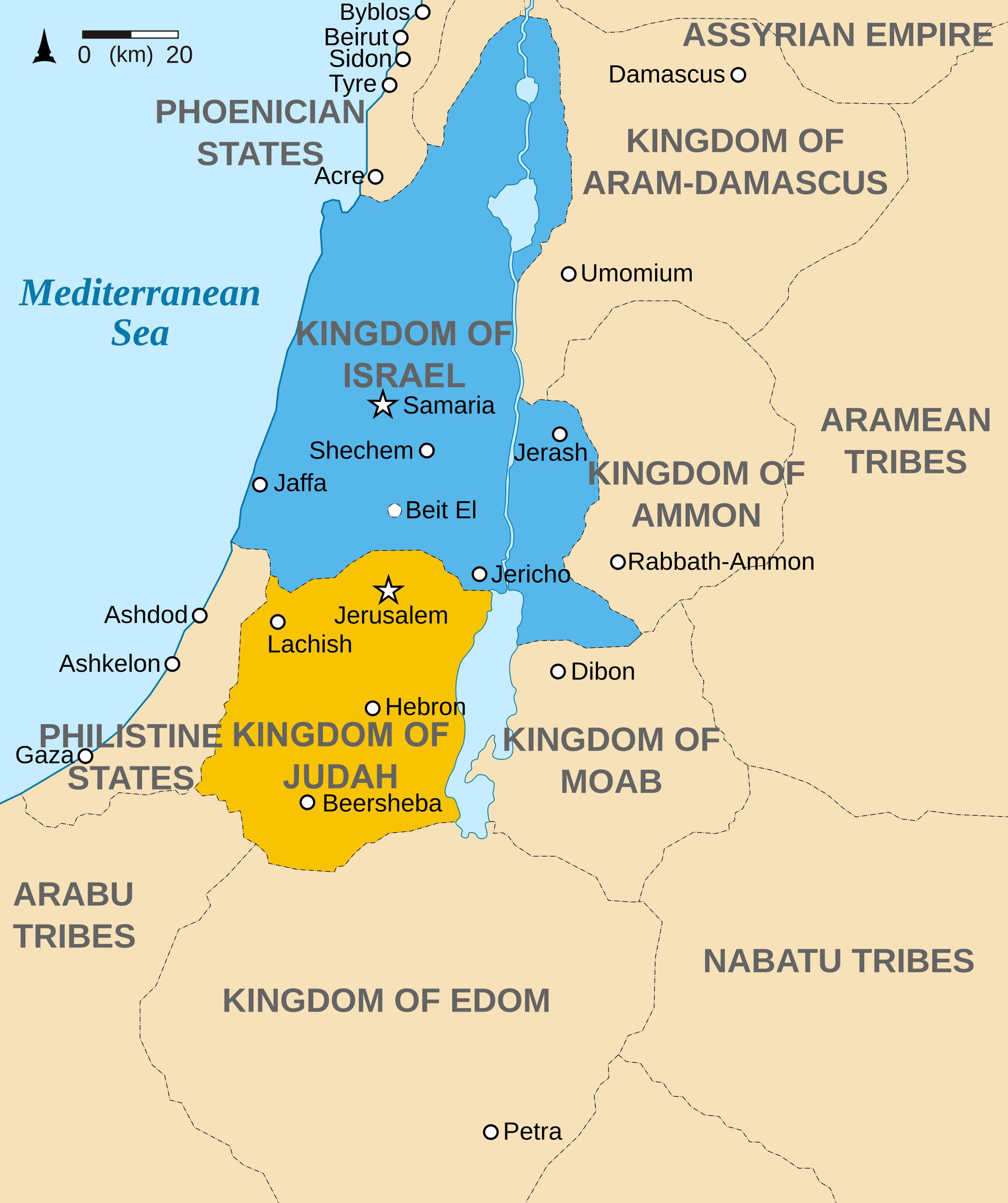
"Kingdoms of Israel and Judah," Wikimedia Commons, https://commons.wikimedia.org/wiki/File:Kingdoms_of_Israel_and_Judah_map_830.svg. CC BY-SA 3.0, https://creativecommons.org/licenses/by-sa/3.0/
↑↑↑ mid source
Byzantine period — The Capture of Jerusalem by the Persians in 614 CE
https://isac.uchicago.edu/sites/default/files/uploads/shared/docs/Publications/LAMINE/lamine5.pdf
Shows Jewish communities still present in Tiberias, Galilee, and the region at the end of Byzantine rule.
“the Jews residing in Tiberias and Mount Galilee”
Early Islamic / caliphal period — Al-Muqaddasi, The Best Divisions for Knowledge of the Regions
https://archive.org/stream/al-muqaddasi-the-best-divisions-for-knowlegde-of-the-region/Al-Muqaddasi%20The%20Best%20Divisions%20for%20Knowlegde%20of%20the%20Region_djvu.txt
Shows Jews remained part of Jerusalem’s population under Muslim rule before the Crusaders.
“the Christians and the Jews are predominant”
Crusader period — Benjamin of Tudela, Itinerary
https://archive.org/stream/the-itinerary-of-benjamin-of-tudela/Marcus%20Nathan%20Adler%20-%20The%20itinerary%20of%20Benjamin%20of%20Tudela.%20Critical%20text%2C%20translation%20and%20commentary-Oxford%20University%20Press%20%281907%29_djvu.txt
Shows Jews living in Jerusalem and Tiberias during the Crusader era.
“about 200 Jews who dwell under the Tower of David”
Mamluk period — Obadiah of Bertinoro, letter from Jerusalem (1488)
https://archive.org/stream/McGillLibrary-108936-464/108936_djvu.txt
Shows a small but real Jewish community still in Jerusalem in the late Mamluk period.
“about seventy families of the poorest class have remained”
Ottoman period — Montefiore Censuses of the Jewish inhabitants of the Holy Land
https://www.montefioreendowment.org.uk/census/
Shows archival censuses of Jewish communities in the Holy Land during the nineteenth-century Ottoman period.
“compiled by Sir Moses Montefiore during his visits to the region between the years 1839 and 1875.”
British Mandate period — Report on the Census of Palestine, 1922, p. 8
https://users.cecs.anu.edu.au/~bdm/yabber/census/PalestineCensus1922.pdf
Shows Jews recorded in Palestine before the establishment of the State of Israel.
“83,794 Jews”
STRONGEST COUNTER ARGUMENTS WORTH KNOWING:
• Jews were not continuously sovereign in the land for 3000 years.
• Jews were not continuously a demographic majority in the land for 3000 years.
• There were periods of expulsion, massacre, displacement, and sharp demographic decline
• But none of that proves the absence of continuous Jewish presence; it proves fluctuating numbers and power
NOTES:
Do not argue the wrong claim
The strong claim is continuous Jewish presence, not continuous uninterrupted Jewish rule or majority
Bad rebuttal:
“Jews ruled the land continuously for 3000 years”
Better rebuttal:
“Jewish communities remained in the land across the centuries even when they were conquered, reduced, or dispersed”
Best one-line rebuttal:
“Jews were not always sovereign or the majority, but Jewish presence in the land continued across the centuries, which is different from claiming 3000 years of uninterrupted Jewish rule”
**see more:
Continuity and Admixture; Levantine Genome History.pdf
Egypt, Israel, and the Levant; Merneptah Stele Narratives.pdf
Israel Exploration Journal, An Aramaic Stele Fragment from Tel Dan.pdf
No Evidence from Genome-wide Data of a Khazar Origin for the Ashkenazi Jews.pdf
Studies in the History and Archaeology of Ancient Israel and Judah.pdf
The genome-wide structure of the Jewish people.pdf
The Genomic History of the Bronze Age Southern Levant.pdf
**Related claims:
Modern Jews are Europeans with no historical connection to the Levant
There is no archaeological evidence that Jews lived in Israel in ancient times
Jews are not indigenous to the land of Israel
yes we've been squatting here for 3 millennia, very sorry