CLAIM:
Jewish immigration under Zionism was an invasion, not return
STATUS:
Misleading
KEY COUNTERPOINTS
-
Calling Jewish immigration under Zionism an “invasion” smuggles in a military frame that does not match how the movement actually began. Modern Zionist immigration began with the First Aliyah in 1881, and from there Jewish migration continued in steady waves through the late Ottoman and British Mandate periods. Much of it consisted of civilians, refugees, workers, religious Jews, and organized settlers entering through migration, land purchase, and later internationally recognized political frameworks. “Invasion” implies an armed entry by a foreign state or army. That is not an accurate description of early Zionist immigration, which began decades before Israel existed and before Jews had any state army to “invade” with.
-
The immigration data shows gradual civilian waves, not a military assault. Jewish immigration into Palestine between 1882 and 1941 moved in distinct waves tied to external pressures — pogroms in Eastern Europe, economic conditions, and Nazi persecution — not coordinated military campaigns. The First Aliyah (1882–1903) brought an estimated 25,000 civilians. The Second Aliyah (1904–1914) brought roughly 37,500. Mandate-period annual figures ranged from under 2,000 to a peak of 66,000 in 1935, the latter accelerated by the Haavara Agreement and Jewish flight from Nazi Germany. Refugees and workers fleeing persecution do not fit the “invasion” frame. An invasion has a command structure, a state actor, and military entry. None of those elements describe what six decades of immigration data actually shows.
-
The “not return” part is also too absolute, because it erases the continuous Jewish historical connection and the explicit language of reconstitution used in international law. The Mandate for Palestine did not describe Jews as a random foreign population with no prior link to the land. It expressly referred to the “historical connection of the Jewish people with Palestine” and the “grounds for reconstituting their national home.” That language matters because “reconstituting” means restoring or rebuilding something with an earlier basis, not inventing a foreign claim from nothing. It does not settle every modern political dispute, but it directly cuts against the claim that Zionist immigration had no return element at all.
-
The strongest opposing argument is not that Jewish immigration was simply an “invasion,” but that sustained Jewish immigration became a settler-national project that threatened the Arab majority and later contributed to dispossession. That critique is more serious and should not be dodged. Arab opposition was not imaginary; many Arabs understood steady Jewish immigration as a demographic and political threat, especially as Zionism became more organized and openly national. But that still does not make “invasion, not return” an accurate summary. The historical record shows both realities at once: a real Jewish return claim rooted in ancient connection, persecution, and national revival, and a real Arab fear of being politically displaced. The one-line claim collapses that tension into propaganda language.
EVIDENCE:
• The Basel Program defined Zionism’s goal as establishing for the Jewish people a “publicly and legally assured home in Palestine,” which is legal-political nationhood language, not invasion language.
• The Mandate for Palestine explicitly recognized “the historical connection of the Jewish people with Palestine” and referred to “reconstituting their national home,” which directly contradicts the claim that there was no return dimension at all.
• Article 6 of the Mandate called for facilitating Jewish immigration under suitable conditions, and Article 7 contemplated citizenship provisions for Jews taking up permanent residence. That is administrative-legal migration policy, not the language of repelling an invading army.
• Herzl’s political Zionism aimed at internationally recognized sovereignty and legal acquisition, not a one-off military assault. That does not remove all colonial criticism, but it does weaken the “invasion” framing.
• Britain later sharply restricted Jewish immigration in the 1939 White Paper and explicitly said Palestine was not to become a Jewish state against Arab will. That undercuts the simplistic idea of a smooth imperial invasion pipeline.
Jewish Immigration to Palestine, 1882–1941
Figures before 1919 are Aliyah-wave estimates, not annual statistics. The WWI period (1915–1918) is left blank due to disruption and unreliable records. From 1919 onward, Mandate-period records allow annual charting. The 1935 peak reflects the Fifth Aliyah driven by General Nazi persecution and The Haavara Agreement (1933).
Pre-1919 estimates:
https://www.cbs.gov.il/he/publications/doclib/2021/2.shnatonpopulation/st02_53.pdf
Post-1919 annual figures:
https://www.researchgate.net/figure/Jewish-immigration-into-Palestine-during-1919-1941-25_fig1_375318014
PRIMARY SOURCES:
• Theodor Herzl, The Jewish State (1896)
https://www.gutenberg.org/files/25282/25282-h/25282-h.htm
Foundational political Zionist text. Best for showing that the movement’s aim was internationally recognized sovereignty and organized legal-political settlement, not a simple military invasion model.
“admit our sovereignty”
• Basel Program, First Zionist Congress (1897)
https://www.gov.il/en/Departments/General/1897-the-first-zionist-congress-takes-place-in-basel
Core statement of formal Zionist aims. Useful because it frames the movement in public-law terms rather than conquest language.
“publicly and legally assured home in Palestine”
• League of Nations Mandate for Palestine (1922)
https://avalon.law.yale.edu/20th_century/palmanda.asp
Most important legal text for this claim. It explicitly recognizes Jewish historical connection and uses “reconstituting” language, while also providing for immigration and citizenship under a legal framework.
“recognition has thereby been given to the historical connection of the Jewish people with Palestine and to the grounds for reconstituting their national home in that country”
• League of Nations Mandate for Palestine, Article 6 and Article 7
https://avalon.law.yale.edu/20th_century/palmanda.asp
Best source for showing that Jewish immigration was treated in the Mandate as an administrative and legal matter, not as armed incursion.
“facilitate Jewish immigration under suitable conditions”
• British White Paper of 1939
https://avalon.law.yale.edu/20th_century/brwh1939.asp
Essential corrective against the claim that imperial backing made the entire process a straightforward colonial invasion from start to finish. Shows British restriction and reversal.
“it is not part of their policy that Palestine should become a Jewish State”
STRONGEST COUNTER ARGUMENTS WORTH KNOWING:
• Large-scale Jewish immigration did change the demographic and political balance of the country. Critics argue that whatever its legal forms, the result was experienced by many Palestinian Arabs as an externally backed settler encroachment.
• Legal entry does not automatically settle moral legitimacy. A movement can operate through law and still be accused of settler colonial effects, especially if the long-run outcome is displacement of another population.
• Some Zionist leaders did use settlement and colonization language common to the age. That does not prove “invasion,” but it does give the opposing side real textual material to work with.
• The return claim does not erase the Arab side of the story. A people can have a real historical connection and still generate a conflict through mass immigration and state-building in a land already inhabited by another population.
NOTES:
The weak word in the opponent claim is “invasion.” That term tries to win the argument before evidence starts. It replaces historical categories like immigration, settlement, nation-building, refugee movement, and political return with a war word.
A sharper response is to split the claim into two parts and hit both separately:
“Invasion” is the wrong category. “Not return” is too absolute.
Do not overstate the rebuttal either. The clean line is not “therefore everything was innocent.” The stronger line is that the record shows a return movement with legal-political recognition that also became a severe conflict with another population. That is much harder to dismiss than a sentimental or absolutist answer.
Important Land-Ownership Context
The land question before 1948 was not as simple as “Jews took land that was all privately owned by Palestinians.” Land in Mandatory Palestine was divided across different legal categories:
- privately owned Jewish land.
- privately owned Arab land, state land.
- land conceded or used by communities.
- unsettled state land.
- and large areas of unregistered or undeveloped land, especially in sparsely populated desert regions.
This matters because many popular arguments erase the legal complexity of Ottoman and British Mandate land categories. At the same time, the map should not be abused to claim that Palestinian Arabs had no land claims or that later displacement did not happen. The accurate point is narrower and stronger: pre-1948 land ownership was mixed, legally complex, and not reducible to the slogan that “all the land was stolen.”
Mandatory Palestine: Land Ownership in 1945
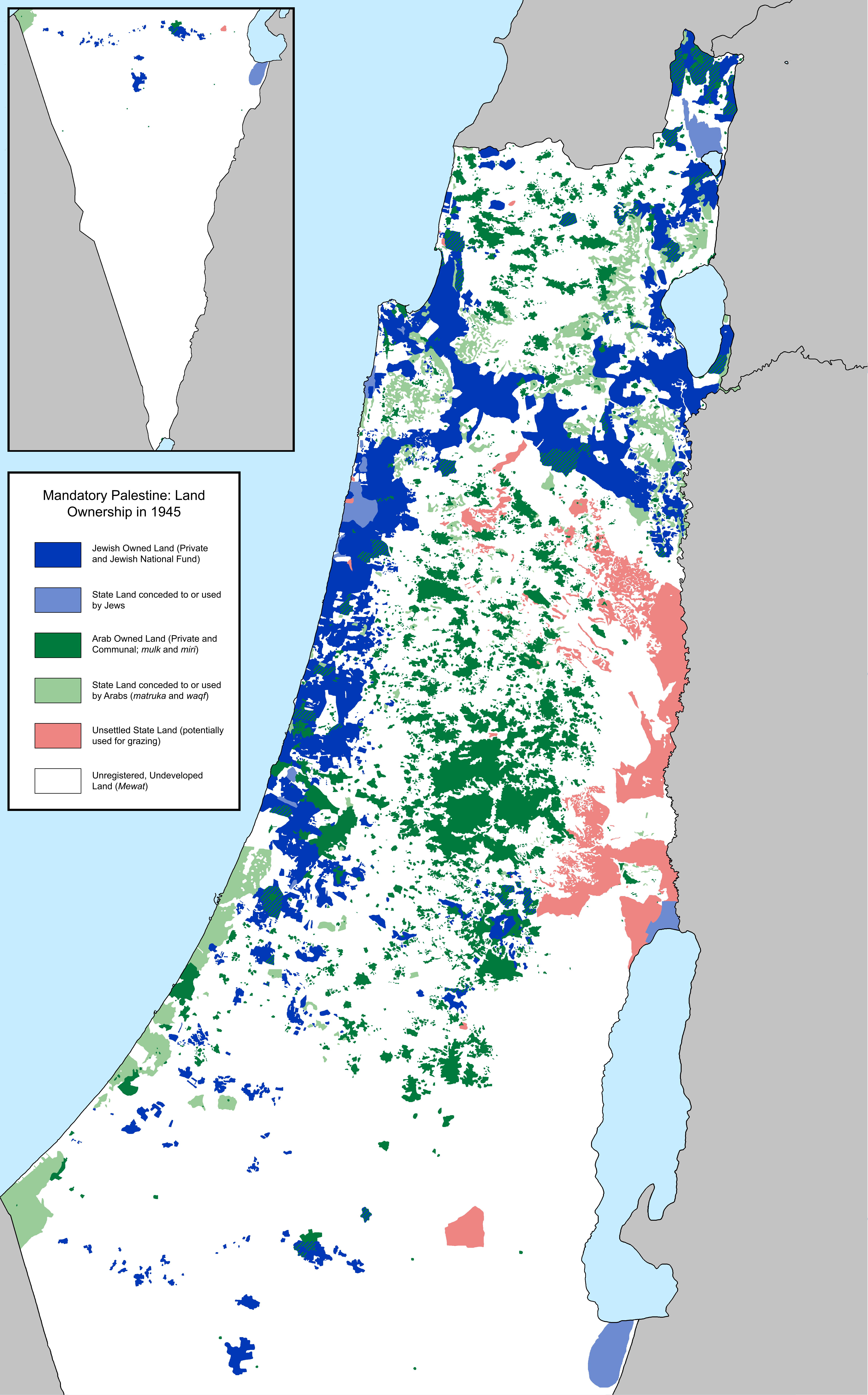
"Mandatory Palestine: Land Ownership in 1945," based on data from the Anglo-American Committee of Inquiry (1946). Wikimedia Commons, CC BY-SA 4.0.
**see more:
Theodor Herzl, A Jewish State.pdf
The Jewish Case Against the Palestine White Paper (Jewish Agency for Palestine, 1939).pdf
Resolutions of the 18th Zionist Congress, Prague, 1933.pdf
Jewish Agency Reports to the 22nd Zionist Congress; Excerpts.pdf
Mandate for Palestine (1922).pdf
British White Paper of 1939.pdf
Biltmore Program (1942).pdf
Balfour Declaration (1917).pdf
Related claims:
Early Zionism aimed to displace the Arab population from the beginning
Zionism was a colonial movement from the start
Zionism was a modern European nationalist movement imported into the Middle East
Israel’s Conflict with Palestine Is a Simple Colonial Settler Project
Jews are not indigenous to the land of Israel
Modern Jews are Europeans with no historical connection to the Levant
Palestine existed as a country before Israel
Zionism is a religious commandment
Zionism is identical to Judaism
Zionism was always extremist