CLAIM:
Jesus was Palestinian.
STATUS:
Misleading / anachronistic.
KEY COUNTERPOINTS:
-
The most precise first-century labels for Jesus are Jewish and Judean, not Palestinian. Matthew places him in “Bethlehem in Judea” and identifies him as the one “born king of the Jews.” Josephus likewise uses territorial language such as “the country of Judea” and “Jerusalem, in the countrey of Judea.” That is the language closest to the period itself. Calling Jesus “Palestinian” replaces the more exact labels with a later, broader, and more politically loaded one.
-
Herodotus proves an old geographic term existed, but not the identity claim being pushed. Herodotus does show that Greeks used “Palestine” before Rome, describing “the part of Syria called Palestine” and saying that “this part of Syria and all as far as Egypt is called Palestine.” That matters. But it is a broad regional description, not a personal identity label for Jesus. It also does not erase the distinction between inland Judea and ancient Philistia on the southern coast. Britannica notes that Philistia was the five-city coastal confederacy of Gaza, Ashkelon, Ashdod, Gath, and Ekron, and that the later Greek name “Palestine” grew from that designation. So the existence of the word does not settle the argument; it only shows an older geographic term, not that “Jesus was Palestinian” is the best historical description.
-
Josephus and later chronology both cut against the slogan. In Against Apion, Josephus quotes Herodotus about “the Syrians that are in Palestine” and adds that no inhabitants of Palestine are circumcised except the Jews. That shows Josephus can use “Palestine” as a broad external geographic label while still treating the Jews as the relevant people under discussion. Separately, the Roman administrative rename to Syria Palaestina comes after the Bar Kokhba revolt in 135 CE, long after Jesus. And if the claim is meant in the modern national sense, Britannica notes that Palestinian national consciousness largely emerged in the 20th century. So whether the claim is leaning on the Roman rename or on modern Palestinian identity, both are later than Jesus.
-
• Map of the Achaemenid Persian Empire c. 500 BCE
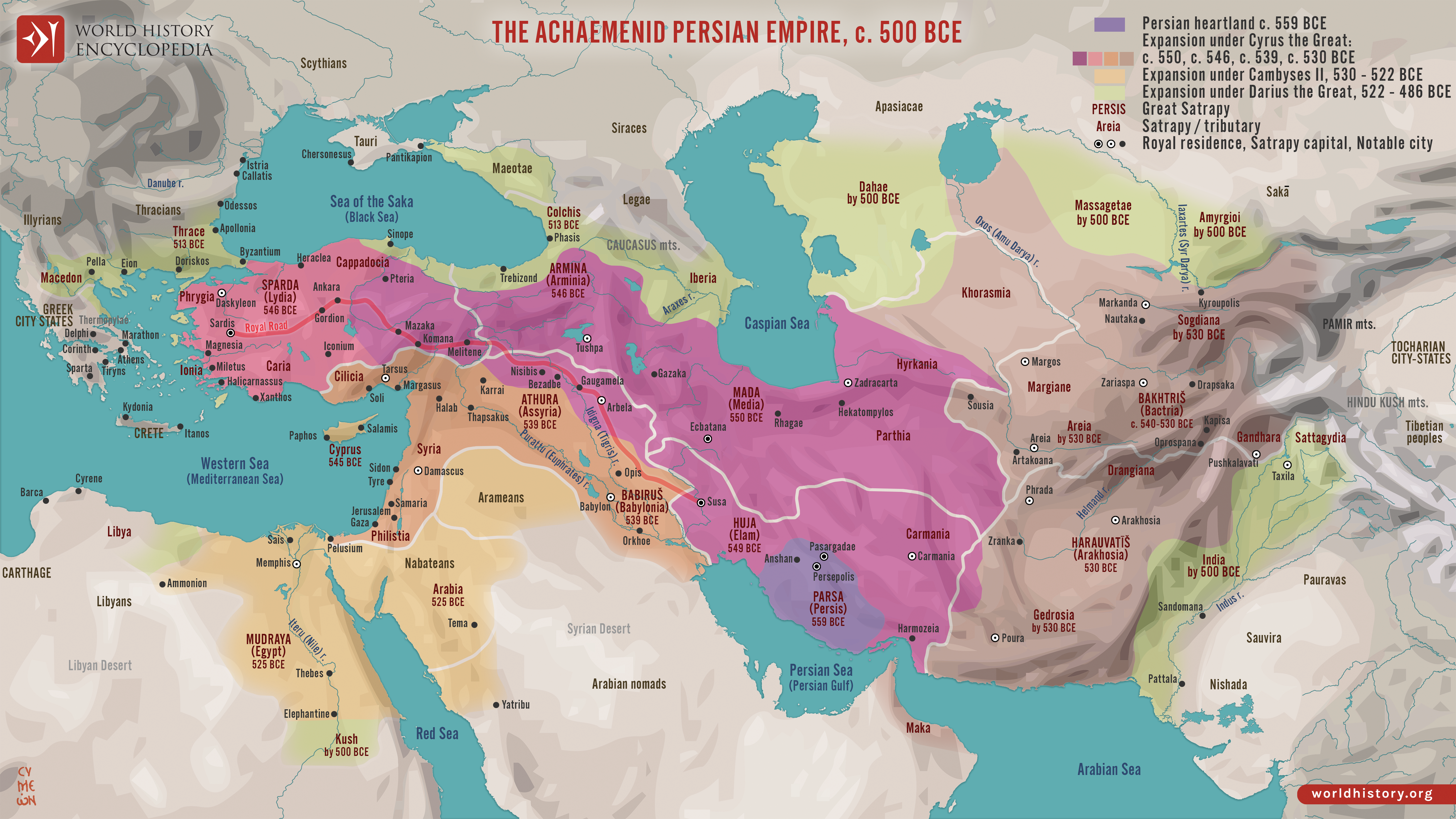
World History Encyclopedia, "The Achaemenid Persian Empire, c. 500 BCE," worldhistory.org CC BY-NC-SA 4.0Secondary historical map by Simeon Netchev, published by World History Encyclopedia. Useful as supporting visual evidence only: it depicts Philistia as a distinct southern coastal zone near Gaza/Ashkelon, separate from inland Judah/Samaria and from Syria to the north. Because the map is dated c. 500 BCE, it supports the narrow point that Philistia was not identical to inland Judah/Judaea, but it should not be used as a standalone proof for Jesus’s own period or to claim with certainty that Herodotus meant only Philistia.
EVIDENCE:
• Matthew 2:1 and 2:5 place Jesus in Bethlehem in Judea.
• Matthew 2:2 identifies Jesus as “king of the Jews,” not as Palestinian.
• Herodotus 3.91 refers to “the part of Syria called Palestine.”
• Herodotus 7.89 says “this part of Syria and all as far as Egypt is called Palestine.” That is a broad geographic usage, not a precise identity label for a 1st-century Judean Jew.
• Josephus says “there are no inhabitants of Palestine that are circumcised excepting the Jews.” That undercuts the attempt to use “Palestine” to displace Jewish identity.
• Josephus also uses “the country of Judea” and “Jerusalem, in the countrey of Judea,” which is the more precise territorial language for the setting in question.
• Ancient Philistia was the coastal pentapolis of Gaza, Ashkelon, Ashdod, Gath, and Ekron. That is not the same thing as Judea, even though the later Greek term “Palestine” grew from that older designation.
• “West Bank” is a modern political-territorial term tied to the post-1949 framework. Saying Jesus was born “in the West Bank” is therefore also anachronistic shorthand, not a historically native label.
PRIMARY SOURCES:
• Matthew 2:1-6
https://www.biblegateway.com/passage/?search=Matthew+2&version=NIV
Birthplace and identity wording from the Gospel narrative. Best anchor for “Bethlehem in Judea” and “king of the Jews.”
“Bethlehem in Judea”
“king of the Jews”
“In Bethlehem in Judea”
• Herodotus, Histories 3.91
https://penelope.uchicago.edu/Thayer/E/Roman/Texts/Herodotus/3d*.html
Primary classical source showing that Greeks used “Palestine” before Rome, but as a regional geographic label.
“the part of Syria called Palestine”
• Herodotus, Histories 7.89
https://lexundria.com/hdt/7.89/mcly
Second Herodotus passage confirming broad regional usage rather than a precise personal identity label.
“this part of Syria and all as far as Egypt is called Palestine”
• Josephus, Against Apion I
https://penelope.uchicago.edu/josephus/apion-1.html
Useful because Josephus directly comments on Herodotus’s “Palestine” wording and still centers the Jews as the relevant circumcised population in that geography.
“The Syrians that are in Palestine are circumcised.”
“there are no inhabitants of Palestine that are circumcised excepting the Jews”
• Josephus, The Jewish War III
https://penelope.uchicago.edu/josephus/war-3.html
Useful because it shows Josephus’s ordinary territorial language: Judea, not “Palestinian” as a personal identity tag.
“the country of Judea”
• Josephus, Antiquities of the Jews XI
https://penelope.uchicago.edu/josephus/ant-11.html
Additional Josephus wording reinforcing Judea as the territorial frame.
“Jerusalem, in the countrey of Judea”
“their countrey of Judea”
• Britannica, “Palestine: Roman Palestine”
https://www.britannica.com/place/Palestine/Roman-Palestine
Reference work for the later Roman rename. Useful against claims that treat the Roman provincial label as if it were Jesus’s own-era identity.
“The province of Judaea was renamed Syria Palaestina”
“About the time the Bar Kokhba revolt was crushed (135)”
• Britannica, “Palestinian”
https://www.britannica.com/topic/Palestinian
Reference work for the modern national-identity point. Useful against the modern-national reading of the claim.
“Palestinians are an Arab people”
“shared national consciousness largely emerged in the 20th century”
• Philistine | Britannica
https://www.britannica.com/topic/Philistine-people
Reference entry confirming that Philistia was the coastal pentapolis centered on Gaza, Ashkelon, Ashdod, Gath, and Ekron, which makes it useful for distinguishing Philistia from inland Judah/Judaea.
“The area contained the five cities of Gaza, Ashkelon, Ashdod, Gath, and Ekron.”
STRONGEST COUNTER ARGUMENTS WORTH KNOWING:
• Herodotus really does show that the word “Palestine” existed before the Roman rename. Denying that is a bad move and gets the easy point lost immediately.
• Some scholars and reference works use “Palestine” loosely for the broader land in antiquity or speak of “Jewish Palestine” as retrospective shorthand. That makes the absolute claim “nobody could ever call Jesus Palestinian in any sense” too rigid. The stronger rebuttal is that it is still a worse and less precise label than “Jewish” and “Judean.”
• The other side’s strongest fallback is not “Jesus was ethnically Palestinian,” but “Jesus was from the land later commonly called Palestine.” That fallback is narrower, but it quietly retreats from the original headline claim.
NOTES:
Do not get trapped into arguing that the word “Palestine” did not exist before Rome. That is the wrong hill to die on. Herodotus is enough to destroy that argument. The better line is: yes, the word existed as a Greek geographic label, but that still does not make “Jesus was Palestinian” the most accurate historical description.
The strongest communication frame is simple: Jesus was a 1st-century Jew from Judea. That is clearer, earlier, and closer to the sources than “Palestinian.”
Do not overclaim that Herodotus meant only the tiny Philistine coastal strip and nothing beyond it. The text itself is broader than that. The safer and stronger point is that Philistia and Judea were not identical, and that a broad Greek regional label does not override the more precise first-century labels in Matthew and Josephus.
“Jesus was born in the West Bank” is also weak framing. Even where it is used as modern shorthand, it is still anachronistic because “West Bank” is a post-1949 political-territorial term.