CLAIM
Israel enforces an illegal occupation.
STATUS
Misleading / Disputed.
KEY COUNTERPOINTS
-
Occupation is not automatically illegal. International law (Hague Regulations, Fourth Geneva Convention) recognizes occupation as a legal regime during armed conflict. The UN Security Council has never declared Israel’s occupation itself illegal, and occupation is legal in cases of armed conflict until a final settlement is reached.
-
No prior Palestinian sovereignty. Israel entered the West Bank in 1967 after Jordan’s unrecognized annexation. There has never been a binding international legal instrument declaring the territory as Palestinian sovereign land. The correct legal term is “disputed territory,” not “occupied Palestinian territory.”
-
Oslo Accords: Divided Governance, Not Simple Occupation. Under the Oslo II Agreement, the West Bank (Judea and Samaria) was divided into three areas:
-
Area A: Major Palestinian cities, where the Palestinian Authority (PA) has full civil and security control.
-
Area B: Palestinian villages and surrounding land, where the PA manages civil affairs and Israel retains overriding security authority.
-
Area C: About 60% of the West Bank, including Israeli settlements and military zones, where Israel retains full civil and security control. This division means the Palestinian Authority governs nearly all Palestinian population centers, and the region is not under a single, undifferentiated Israeli military regime.
-
-
The ICJ’s July 2024 advisory opinion found prolonged occupation and settlement expansion unlawful, but advisory opinions are non-binding and the court’s reasoning is legally contested. The opinion held that Israel’s continued presence in the oPt is unlawful and called for withdrawal. It also found violations of CERD Article 3 on racial segregation. However, the court did not issue a binding judgment. Advisory opinions carry no enforcement mechanism and do not obligate states the way contentious case rulings do. The court also declined to determine the final status of the territory or rule on the conduct of the Gaza war. Israel and a significant number of states have contested the opinion’s legal reasoning, particularly on the question of whether prolonged occupation transforms its legal character. Israel maintains that final status must be resolved through negotiation as set out in the Oslo framework.
-
The British Mandate gave prior legal recognition to Jewish settlement rights. The San Remo Resolution (1920) and the British Mandate for Palestine explicitly recognized the right of the Jewish people to settle in the territory. This predates any Jordanian or Palestinian legal claim and constitutes an internationally recognized legal foundation for Jewish presence in the land.
-
Jordan’s 1948 annexation of the West Bank was itself illegal. Jordan’s annexation was recognized by only two countries (the UK and Pakistan) and was widely condemned as illegitimate. If the annexation was invalid, Israel did not displace a recognized sovereign in 1967. The West Bank was therefore not “Palestinian territory” in any legally binding sense when Israel entered in 1967.
-
Resolution 242 is non-binding and does not declare the occupation illegal. UN Security Council Resolution 242 uses recommendatory, not mandatory, language. It calls for negotiation and a land-for-peace framework, not unilateral Israeli withdrawal. Its drafters explicitly stated that “territories” was used without the definite article “the” intentionally, meaning withdrawal from some, not all, occupied territories was the standard envisioned. Resolution 242 does not say the occupation is illegal.
-
Palestinians have rejected statehood offers repeatedly. The argument that Israel is blocking Palestinian self-determination ignores a consistent pattern of Palestinian rejection of negotiated solutions:
-
1937 - Peel Commission partition plan: rejected by the Arab Higher Committee.
-
1947 UN Partition Plan (Resolution 181): rejected by Arab states and Arab leadership.
-
2000 - Camp David Summit: Yasser Arafat rejected Ehud Barak’s offer of a Palestinian state including Gaza, most of the West Bank, and a capital in East Jerusalem.
-
2000–2001 - Clinton Parameters / Taba talks: Clinton proposed a final-status framework for a Palestinian state in Gaza and most of the West Bank, with land swaps, Jerusalem arrangements, security terms, and refugee provisions. Both sides responded with reservations, but Clinton later said Arafat’s reservations went beyond the parameters. Taba narrowed some gaps, but no agreement was reached.
-
2008 - Ehud Olmert’s offer: Palestinian Authority President Mahmoud Abbas rejected an offer widely considered more generous than Camp David, with no counter-offer made. This pattern shifts moral and legal responsibility for the unresolved status significantly onto Palestinian leadership, and undermines the claim that Israel alone is perpetuating the situation.
-
Context note: 1967 - Khartoum Resolution: Arab League states answered post-war diplomacy with the “three no’s”: no peace, no recognition, no negotiation with Israel. Useful as evidence of regional rejectionism, but it should be kept separate from the statehood-offer timeline.
-
EVIDENCE
-
Hague Regulations and the Fourth Geneva Convention define occupation as a temporary legal regime, not a crime.
-
The Israeli Supreme Court and official Israeli policy recognize the West Bank as under “belligerent occupation,” but not as sovereign Israeli territory.
-
The UN Security Council has never declared Israel’s occupation illegal; occupation law is designed for temporary control after conflict.
-
Oslo II and interim agreements created divided governance in the West Bank, with the Palestinian Authority exercising civil powers in Areas A and B.
-
The ICJ’s July 2024 advisory opinion found Israel’s continued presence in the oPt unlawful and called for withdrawal, and found specific West Bank policies breach CERD Article 3. The opinion is non-binding, was contested by Israel and a number of states, and did not determine final territorial status or rule on the Gaza war.
-
Israel’s legal position: the territories are disputed, not occupied from a prior sovereign, and their status must be resolved by negotiation.
-
The San Remo Resolution and the British Mandate for Palestine granted internationally recognized rights for Jewish settlement in the territory west of the Jordan River, prior to any Arab sovereign claim.
-
Jordan’s annexation of the West Bank (1948-1967) was rejected by the international community and does not constitute legitimate prior sovereignty.
-
Resolution 242’s drafters, including British Ambassador Lord Caradon and U.S. legal advisor Eugene Rostow, confirmed the omission of “the” before “territories” was deliberate, meaning partial withdrawal was contemplated.
-
Palestinian leadership rejected formalized statehood offers in 1937, 1947, 2000, and 2008, each time without a viable counter-offer.
UNGA Vote Requesting the ICJ Occupation Advisory Opinion (Resolution 77/247, December 2022)
Resolution 77/247 was a UN General Assembly vote requesting the ICJ to issue an advisory opinion on whether Israel’s presence in the occupied Palestinian territory is unlawful. It passed by 87 in favour, 26 against, and 53 abstentions. That means 106 of 193 UN member states, over half, either voted against or withheld support from even requesting the opinion in the first place. The UK voted against, and a significant bloc of EU members abstained rather than support the resolution. The resolution passed because the OIC and Non-Aligned Movement bloc carried it, not because of genuine global legal consensus. When someone says “the international community considers the occupation illegal” they are describing 45% of UN membership — heavily concentrated in one geopolitical bloc. That is not consensus. That is a political majority in one multilateral body reflecting existing geopolitical alignments, not settled legal opinion.
Source: https://www.icj-cij.org/node/202803
PRIMARY SOURCES
Hague Regulations (1907), Article 42
https://ihl-databases.icrc.org/en/ihl-treaties/hague-conv-ii-1899/regulations-art-42
Defines military occupation as a recognized legal condition under international law, not a crime. The threshold rebuttal to the accusation: occupation law exists precisely because occupation can be lawful.
“Territory is considered occupied when it is actually placed under the authority of the hostile army.”
↑↑↑ Best source!
ICJ Advisory Opinion, Legal Consequences arising from the Policies and Practices of Israel in the Occupied Palestinian Territory, including East Jerusalem, 19 July 2024
https://www.icj-cij.org/sites/default/files/case-related/186/186-20240719-adv-01-00-en.pdf
ICJ Advisory Opinion, Occupied Palestinian Territory, 2024.pdf
The court found Israel’s continued presence in the oPt unlawful and called for withdrawal. Found settlement expansion constitutes annexation of large parts of the West Bank. Found specific policies breach CERD Article 3. Non-binding. Does not determine final territorial status. Does not rule on the Gaza war. Israel and a number of states contested the legal reasoning. Essential to engage rather than ignore; the defensible response is to distinguish advisory from binding and acknowledge what the court did and did not find.
“The Court emphasizes that the conclusion that Israel’s continued presence in the Occupied Palestinian Territory is illegal does not release it from its obligations and responsibilities under international law, particularly the law of occupation, towards the Palestinian population.” Para. 264.
↑↑↑ best source!
J. Lawrence Hargrove, testimony quoted in Eugene Rostow’s “The Drafting of Security Council Resolution 242”
https://openyls.law.yale.edu/server/api/core/bitstreams/432d0f29-e276-4a1c-bb0e-ad0f4d660c01/content
After the 1967 Six Day War, the UN Security Council passed Resolution 242 calling for Israeli withdrawal from “occupied territories.” The Arab states and many international critics argued this meant full withdrawal to the exact pre-war June 4, 1967 lines.
The resolution was deliberately written in English as:
“Withdrawal of Israeli armed forces from occupied territories”
Not:
“Withdrawal of Israeli armed forces from the occupied territories”
That one missing word was fought over intensively during drafting. The Soviet Union and Arab states pushed for “the” to be included. The United States and United Kingdom blocked it.
Hargrove was the U.S. international law adviser physically present during the Resolution 242 drafting in 1967. He testifies that the omission was deliberate and understood by all sides at the time to mean Israel was not required to withdraw to the exact pre-war lines. The final borders were left open for negotiation in a peace settlement.
Withdrawal yes, but not necessarily from every inch.
This is first-hand drafter testimony, not a later interpretation.
“The language ‘from territories’ was regarded at the time of the adoption of the resolution as of high consequence because the proposal put forward by those espousing the Egyptian cause was withdrawal from ‘the territories.’”
“Consequently, the omission of ‘the’ was intended on our part, as I understood it at the time, and was understood on all sides, to leave open the possibility of modifications in the lines which were occupied as of June 4, 1967, in the final settlement.”
pp. 501-502
↑↑↑ Best direct quote for the missing “the” argument!
UN Security Council Resolution 242 (1967) https://peacemaker.un.org/sites/default/files/document/files/2024/05/scres24228196729.pdf
Non-binding resolution calling for negotiated land-for-peace. Calls for withdrawal from “territories,” not “all territories.” Contains a reciprocal requirement for Arab states to recognize Israel’s right to peace and security. Does not declare the occupation illegal.
“Withdrawal of Israel armed forces from territories occupied in the recent conflict.”
“Termination of all claims or states of belligerency and respect for and acknowledgment of the sovereignty, territorial integrity and political independence of every State in the area.”
↑↑↑ best source!
Oslo II Agreement (Interim Agreement on the West Bank and Gaza Strip, 1995)
https://peacemaker.un.org/sites/default/files/document/files/2024/05/il20ps950928interimagreementwestbankgazastrip28osloii29.pdf
Establishes Areas A, B, and C with differentiated governance structures. Directly counters the claim of a single undifferentiated Israeli military occupation across all territory.
“Israel, through its military government, has the authority over areas that are not under the territorial jurisdiction of the Council, powers and responsibilities not transferred to the Council and Israelis.”
Article XVII, Jurisdiction, paragraph 4(a), page 22
↑↑↑ best source!
British Mandate for Palestine (1922)
https://avalon.law.yale.edu/20th_Century/Palmanda.asp
League of Nations Mandate instrument for Palestine. Article 6 required the Administration of Palestine to facilitate Jewish immigration and encourage close Jewish settlement on the land, while also requiring that the rights and position of other sections of the population not be prejudiced.
“The Administration of Palestine, while ensuring that the rights and position of other sections of the population are not prejudiced, shall facilitate Jewish immigration under suitable conditions and shall encourage, in co-operation with the Jewish agency referred to in Article 4, close settlement by Jews on the land, including State lands and waste lands not required for public purposes.”
Article 6
↑↑↑ Best source for Mandate-era Jewish immigration and land-settlement authorization.
San Remo Resolution (1920)
https://ecf.org.il/media_items/299
Decision of the Principal Allied Powers assigning the Mandate for Palestine to Britain with the explicit purpose of facilitating a Jewish national home, incorporating the Balfour Declaration. The foundational international instrument predating all subsequent Jordanian and Palestinian legal claims over the territory.
↑↑↑ mid source
Fourth Geneva Convention (1949)
https://ihl-databases.icrc.org/en/ihl-treaties/gciv-1949
Establishes the legal obligations of occupying powers and presupposes that occupation is a lawful temporary condition subject to specific rules. The existence of this framework confirms occupation is not inherently criminal.
↑↑↑ mid source
SETTING THE RECORD STRAIGHT, ISRAEL AND AGENDA ITEM 7
SETTING THE RECORD STRAIGHT, ISRAEL AND AGENDA ITEM 7.pdf
Comprehensive rebuttal of common legal claims made against Israel at the UN, including the occupation framing. Internal archive reference only. No verified public URL. Do not cite as a public source without a verified external link.
↑↑↑ mid source
STRONGEST COUNTER ARGUMENTS WORTH KNOWING
-
The ICJ’s 2024 advisory opinion and recent UN resolutions call Israel’s prolonged presence and settlement policy unlawful and demand withdrawal. While advisory opinions are non-binding, they carry significant political weight and reflect a growing international consensus.
-
Critics argue that the cumulative effect of settlement expansion, movement restrictions, and denial of Palestinian political rights constitutes a de facto annexation that goes beyond permissible occupation under international law.
-
Some legal scholars argue that even if the original 1967 occupation was lawful, its duration and the integration of settlements have transformed it into something the original legal framework did not anticipate or permit.
-
The repeated rejection of statehood offers is contested: Palestinian negotiators argue the offers were insufficient in scope, sovereignty, and contiguity, and that characterizing them as generous is itself disputed.
NOTES
On Counterpoint 2 (No prior Palestinian sovereignty): This is the weakest standalone claim in the document. Occupation under international law does not require displacing a prior sovereign state, it can apply to territories as well. So technically, the absence of Palestinian sovereignty does not by itself defeat the occupation argument. However, the claim still carries tactical value as a supporting argument: it removes a layer of the opponent’s framing, reinforces the “disputed territory” framing over “occupied Palestinian territory,” and strengthens the overall case when used alongside the other counterpoints rather than on its own.
The strongest single line: occupation is a recognized legal regime under international law, not a crime, and Resolution 242 is non-binding recommendatory language, not a legal ruling against Israel.
The Palestinian rejection pattern (1937, 1947, 2000, 2008) is one of the most underused arguments in this debate. It directly challenges the framing that Israel is unilaterally blocking peace and statehood.
Jordan’s illegal annexation point is also consistently overlooked and tactically strong: it removes the premise that Israel displaced a recognized sovereign in 1967.
When discussing Resolution 242, always lead with the drafters’ own stated intent. Lord Caradon and Eugene Rostow are primary sources that directly contradict the “full withdrawal” interpretation that critics rely on.
For further knowledge, this is the Israel-Palestine Territorial Control Timeline 1888-2023
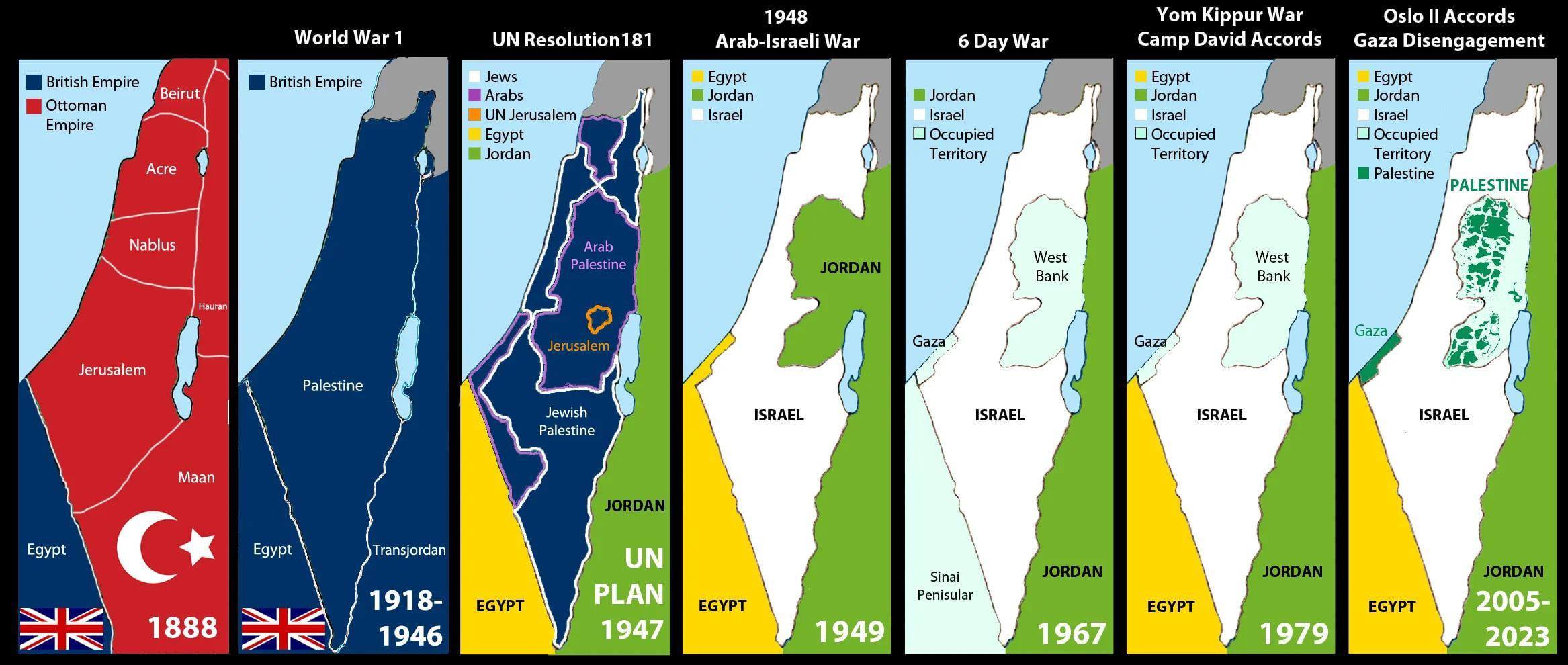
CAMERA (Committee for Accuracy in Middle East Reporting and Analysis), "Israel-Palestine Territorial Control Timeline, 1888–2023," camera.org
see more:
Basic Law; Israel, The Nation State of the Jewish.pdf
Declaration of the Establishment of the State of Israel, 1948.pdf
ICJ Advisory Opinion, Construction of the Wall in the Occupied Palestinian Territory, 2004.pdf
IHRA Working Definition of Antisemitism, 2016.pdf
International Convention on the Suppression and Punishment of the Crime of Apartheid, 1973.pdf
UN Security Council Resolution 242, 1967.pdf
SETTING THE RECORD STRAIGHT, ISRAEL AND AGENDA ITEM 7.pdf
Related claims:
Israel is a theocracy
Israel is a Jewish supremacist state
Israel is an apartheid state
CLASSIFIED: This note contains dangerous levels of context.