CLAIM:
Israel Started the 1967 Six-Day War
STATUS:
Misleading
KEY COUNTERPOINTS
-
Israel launched the first strike, but not the first act of war. On June 5, 1967, Israel conducted a large-scale preemptive air strike against Egyptian airfields. That is not in dispute. What the claim omits is that by June 5, Egypt had already remilitarized the Sinai Peninsula, expelled the UN buffer force, and closed the Straits of Tiran to Israeli shipping. These were not diplomatic gestures — they were material changes to the military and strategic situation that had kept the border stable since 1956. The war's first shot and the war's cause are not the same thing.
-
Egypt dismantled the postwar order before June 5. The United Nations Emergency Force had separated Egyptian and Israeli forces in the Sinai since the 1956 Suez War. On May 18, 1967, Egypt formally demanded its removal. The UN Secretary-General complied. With UNEF gone, the Sinai frontier, previously buffered, was now a direct confrontation line between massed Egyptian forces and Israel. This was Egypt’s decision, documented in the UN’s own records, made nearly three weeks before any Israeli strike.
-
The Straits of Tiran closure was recognized in real time as an act of aggression. On May 22, Egypt closed the Straits of Tiran — Israel’s only maritime route to East Africa and Asia. This was not a symbolic move. In a May 26 meeting with President Johnson, Israeli Foreign Minister Eban described it as an act of aggression aimed at Israel’s strangulation. Johnson’s own administration framed its dilemma as a choice between acquiescing in an Israeli response, breaking prior U.S. commitments to Israel’s right of passage, or finding a diplomatic solution. President Johnson himself later identified the Straits closure as the single act most responsible for the explosion of hostilities.
-
A multi-front coalition had already formed. Before June 5, Jordan formally joined the Arab coalition, placing Israel under realistic threat from the west and east simultaneously, in addition to the south. U.S. official history notes this as a factor that heightened pressure on Israel’s decision-making. The war Israel launched was not against a neutral neighbor — it was launched into an already-activated regional coalition.
-
U.S. official history connects Israel’s decision to failed diplomacy, not aggression. The State Department’s own documentary summary of the crisis states that Israel went to war after concluding that international efforts to reopen the Straits of Tiran were not going to be effective. That framing — a state acting after diplomacy failed — is categorically different from the framing embedded in “Israel started the war.”
EVIDENCE
• U.S. official history identifies the crisis origin as the false Soviet intelligence report of May 13, 1967, passed to Egypt, which triggered Egyptian force deployments into Sinai.
• Egypt formally requested UNEF’s withdrawal on May 18, 1967. The UN Secretary-General’s report confirms UNEF was withdrawn because Egyptian consent for its presence was rescinded — approximately 18 days before the Israeli strike.
• The Straits of Tiran were closed to Israeli shipping on May 22, 1967, cutting Israel’s only maritime access to East Africa and Asia.
• A CIA memorandum dated June 5, 1967 concludes that available information indicated Israel fired the first shots of the war that day.
• The White House President’s Daily Brief for June 5, 1967 records that Israeli planes struck Egyptian airfields and that the signs pointed to an Israeli initiative.
• The State Department’s FRUS summary states directly that Israel went to war after concluding that the international response to the Straits closure would not be effective.
• Jordan joined the Arab coalition before June 5, creating a multi-front threat that U.S. official history cites as a factor heightening pressure toward an Israeli strike.
• President Johnson stated on June 19, 1967 that the Straits closure was the act most responsible for the outbreak of hostilities — not an Israeli provocation.
PRIMARY SOURCES
Foreign Relations of the United States, 1964–1968, Volume XIX — Summary
https://history.state.gov/historicaldocuments/frus1964-68v19/summary
Official U.S. government documentary summary of the full crisis chronology, from the false Soviet warnings of May 13 through the war’s conclusion. Directly connects Israel’s decision to the failure of international diplomacy over the Straits, rather than presenting June 5 as an unprovoked act.
“Israel went to war when the Israeli government realized that efforts to develop an international response to Egypt’s closure of the strait of Tiran were not going to be effective.”
FRUS Vol. XIX, Document 151 — President’s Daily Brief, June 5, 1967
https://history.state.gov/historicaldocuments/frus1964-68v19/d151
Contemporaneous White House intelligence document from the first morning of the war. Confirms Israel conducted the opening air strikes and that U.S. intelligence assessed the initiative as Israeli. Essential for maintaining the honest concession that Israel struck first.
“Israeli planes raided airfields in Cairo and other areas beginning at about 8:00 AM local time… the signs point to this as an Israeli initiative.”
FRUS Vol. XIX, Document 169 — CIA Memorandum: “The Arab-Israeli War: Who Fired the First Shot?” June 5, 1967
https://history.state.gov/historicaldocuments/frus1964-68v19/d169
A declassified CIA assessment produced on the first day of hostilities, addressing the first-shot question directly. Its title alone makes it a high-value citation. The conclusion is narrow and careful — it confirms Israel fired first without making broader causal claims.
“An analysis of presently available information suggests that Israel fired the first shots today.”
Report of the Secretary-General on the Withdrawal of the United Nations Emergency Force, June 26, 1967
https://www.un.org/unispal/document/auto-insert-182090/
The official UN record of Egypt’s demand for UNEF’s removal and the UN’s compliance. Establishes that the buffer separating Egyptian and Israeli forces since 1956 was dismantled by Egypt’s own decision, nearly three weeks before the Israeli strike.
“The Government of the United Arab Republic has the honour to inform Your Excellency that it has decided to terminate the presence of the United Nations Emergency Force… UNEF is being withdrawn because the consent of the Government of the United Arab Republic for its continued deployment has been rescinded.”
FRUS Vol. XIX, Document 77 — Memorandum of Conversation: President Johnson and Foreign Minister Eban, May 26, 1967
https://history.state.gov/historicaldocuments/frus1964-68v19/d77
Official U.S. record of the key pre-war diplomatic meeting. Demonstrates that both the U.S. and Israeli governments treated the Straits closure as a live crisis in real time — not a post-hoc justification. Eban’s language is explicit about the severity of the act.
“If Israel is denied access to the Gulf of Aqaba, its primary line to East Africa and Asia — half of the world — would be cut off. Nasser has committed an act of aggression and his objective is the strangulation of Israel.”
Address at the State Department’s Foreign Policy Conference for Educators — President Lyndon B. Johnson, June 19, 1967
https://www.presidency.ucsb.edu/documents/address-the-state-departments-foreign-policy-conference-for-educators
Public presidential statement three weeks after the war ended. Johnson directly identifies the Straits closure — an Egyptian act — as the central trigger for the conflict. Significant because the source is neither Israeli nor Arab, but the sitting U.S. president.
“If a single act of folly was more responsible for this explosion than any other, I think it was the arbitrary and dangerous announced decision that the Straits of Tiran would be closed.”
STRONGEST COUNTERARGUMENTS WORTH KNOWING
• Israel did fire first, and that is not deniable. Both the CIA memorandum and the White House daily brief of June 5 confirm it. Any response that flatly denies this loses credibility immediately.
• Preemption is not automatically lawful self-defense. Even granting serious escalation, critics can argue that the legal threshold of imminent attack was not clearly met, and that Israel chose preventive war rather than waiting to absorb a first blow. U.S. officials explicitly urged Israel not to initiate hostilities in the days prior.
• U.S. intelligence did not assess Arab attack as imminent when Eban visited Washington. The FRUS record notes that American intelligence at the time did not conclude that an Arab offensive was hours away — even though Israel believed the danger was grave. The strongest version of this rebuttal should not claim all major actors agreed that invasion was imminent.
• Israel had strategic incentives beyond pure defense. Some historians argue Israel saw the crisis as an opportunity to deal a decisive blow to Arab military capabilities it had long viewed as existential threats — complicating any clean narrative of purely reactive self-defense.
NOTES
Do not accept the frame "first strike = sole aggressor." That is the core trap in this claim. The clean and defensible response is: Israel launched the first major strike on June 5, but the war crisis was already underway — Egypt had remilitarized Sinai, expelled UNEF, closed the Straits, and a multi-front Arab coalition had formed before a single Israeli plane left the ground.
The most effective one-line pivot is: “Israel struck first on June 5, but Egypt had already dismantled the postwar order before that day.” That stays honest while refusing the false simplification.
Avoid any flat claim like “Israel definitely did not start the war.” That hands the opposing side an immediate and legitimate rebuttal using the June 5 strike. The stronger and more defensible line is that the claim is misleading because it mistakes the first shot for the full cause.
When pushed on legality, the stronger ground is factual and chronological — not legal. Legal arguments about imminence are contested and vulnerable. The evidentiary record of what Egypt did in May 1967, and what U.S. officials said at the time, is not.
Context of the territories:
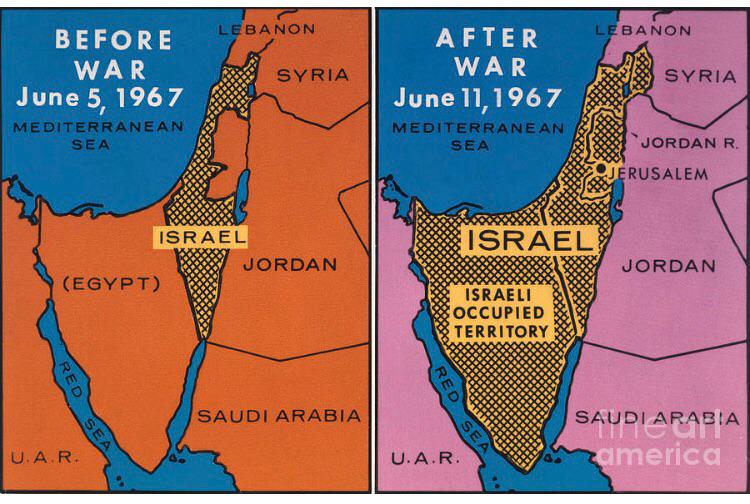
Granger Historical Picture Archive / Fine Art America, "1967 Six Day War Before and After Map," fineartamerica.com — ⚠️ fully copyrighted, license required before public distribution
**See more
Wars and conflict references
Israel–Palestine foundational documents
RELATED CLAIMS:
Israel enforces an illegal occupation
Israel’s Conflict with Palestine Is a Simple Colonial Settler Project
The Conflict Began Only in 1948
Palestinians broadly support a two-state solution