CLAIM:
The Israel-Palestine conflict only began in 1948 when Israel was created.
STATUS:
False.
KEY COUNTERPOINTS:
-
Organized Arab violence against Jewish communities in Palestine began in 1920 -- 28 years before Israel's declaration of independence. British military administrators documented this from the first year of the Mandate.
-
The British government convened multiple formal commissions of inquiry — in 1920, 1921, and 1930 — each responding to separate, major outbreaks of Arab-initiated violence against Jewish civilians. These were not border skirmishes between two armies; they were attacks on urban Jewish neighborhoods and ancient communities decades before any Israeli state existed.
-
Arab leadership formally and explicitly rejected every partition proposal before 1948 — the 1937 Peel Commission plan, the 1938 Woodhead Commission plan, and the 1947 UN Resolution 181 — and announced in advance their intention to use force to prevent a Jewish state. The 1948 war did not come out of nowhere; it was the declared intention of Arab states for years.
EVIDENCE:
-
1920 Nebi Musa riots: Arab crowds in Jerusalem attacked Jewish neighborhoods during a religious festival, killing 5 Jews and wounding over 200. The British convened the Palin Commission to investigate. British military governor Ronald Storrs described the violence as destroying all carefully built relations between communities.
-
1921 Jaffa riots: Arab mobs attacked Jewish residents of Jaffa, killing 47. The British Haycraft Commission found Arab hostility to Jewish immigration was a central driver.
-
1929 Hebron massacre: Arab mobs killed 67 Jews in Hebron — a community present for 800 years — in two days. Jewish synagogues were desecrated, a hospital treating Arab patients was ransacked. The British Shaw Commission called it “a most ferocious attack” and “savage.” Sparked by a fabricated rumor that Jews were planning to seize Al-Aqsa Mosque, which the British confirmed was false.
-
1936-1939 Arab Revolt: A sustained three-year campaign explicitly aimed at ending Jewish immigration and halting partition. The Peel Commission — appointed specifically because the conflict had become ungovernable — concluded for the first time that the British Mandate was unworkable and that Jewish and Arab national aspirations were irreconcilable.
-
Arab rejection of the 1937 Peel Commission partition plan: Arab leadership rejected the proposal outright and intensified violence. Jewish leadership accepted it in principle.
-
May 15, 1948 -- Arab state invasion: The day after Israel declared independence, Egypt, Syria, Jordan, Lebanon, and Iraq launched a coordinated military invasion. The Arab League Secretary-General had warned the UN in advance that the Arab states would intervene by force.
PRIMARY SOURCES:
Shaw Commission Report (1930) — British Government Inquiry into the 1929 Palestine Riots https://britainpalestineproject.org/wp-content/uploads/2021/01/shaw-commission-reducedpdf_compressed-1.pdf The official British inquiry chaired by Sir Walter Shaw. Documented the Hebron massacre in detail. Attributed primary responsibility to Arab attackers. Identified Arab fears of Jewish immigration as the fundamental underlying cause — not Israeli policy, which did not yet exist.
“Arabs in Hebron made a most ferocious attack on the Jewish ghetto and on isolated Jewish houses lying outside the crowded quarters of the town. More than 60 Jews — including many women and children — were murdered and more than 50 were wounded. This savage attack, of which no condemnation could be too severe, was accompanied by wanton destruction and looting.”
Peel Commission Report (1937) — Palestine Royal Commission https://www.britannica.com/event/Peel-Commission
The report that conclusively declared the Mandate unworkable due to irreconcilable Arab-Jewish conflict — years before 1948. Its existence alone falsifies the claim that the conflict “only began” in 1948.
“The report admitted that the mandate was unworkable because Jewish and Arab objectives in Palestine were incompatible.”
Palin Commission Report (1920) — British Military Investigation into the Nebi Musa Riots https://users.cecs.anu.edu.au/~bdm/yabber/yabber_palin.html
The first major British investigative report on Arab-Jewish violence in Mandatory Palestine. Convened in 1920. Establishes that organized violence against Jewish communities began at the very start of the Mandate period.
“The first major ‘disturbance’ occurred in Jerusalem on April 4-7, 1920…The Army appointed a commission headed by Major-General Palin to enquire into the circumstances of the riot.”
British Mandate Census of Palestine (1922) https://users.cecs.anu.edu.au/~bdm/yabber/census/PalestineCensus1922.pdf
The first official demographic record of Mandatory Palestine. Establishes the population baseline against which all subsequent immigration and conflict claims should be measured.
[Demographic tables documenting Jewish and Arab population distributions across Mandatory Palestine as of 1922 — use for context on pre-conflict population data.]
Survey of Palestine (1945-1946) — Prepared for the Anglo-American Committee of Inquiry https://yplus.ps/wp-content/uploads/2021/01/A-SURVEY-OF-PALESTINE-DEC-1945-JAN-1946-VOL-I.pdf A comprehensive British Mandatory survey covering population, immigration, land ownership, and agriculture. Produced three years before 1948, documenting a conflict already fully underway.
“Volume I covers: population and immigration, land ownership and land tenure systems, and agriculture and industry.”
STRONGEST COUNTER ARGUMENTS WORTH KNOWING:
-
The scale and character of the conflict did change dramatically in 1947-1948. The involvement of regular Arab armies, the mass refugee displacement on both sides, and the formalization of frontlines represents a qualitatively different phase of the conflict. Acknowledging that 1948 was a turning point is not the same as accepting that it was the starting point.
-
Many Palestinians and scholars argue that 1948 is the defining moment because of the Nakba — the displacement of 700,000 Palestinian Arabs during and after the war. This is a legitimate historical reality. The displacement happened. Acknowledging pre-1948 violence does not erase the Nakba; both are true simultaneously.
-
Some historians argue that early Arab violence was a response to British imperial policy and rapid demographic change, not purely driven by antisemitism or ethnic hatred. This framing has some merit as a contributing factor analysis. However, explaining the causes of violence is different from denying that the violence happened or that it predates 1948.
NOTES:
The most efficient rebuttal to this claim is a simple question: what were the Palin Commission (1920), the Haycraft Commission (1921), and the Shaw Commission (1930) investigating? Each one was a British government inquiry into major outbreaks of Arab violence against Jews in Palestine — in 1920, 1921, and 1929, respectively. If the conflict only started in 1948, why was Britain holding formal commissions of inquiry into it 28 years earlier?
Tactical communication note: This claim often serves as a rhetorical gateway to the argument that Israel is the cause of all regional instability, and that the Middle East would be peaceful without it. The pre-1948 record closes that argument directly. The 1937 Peel Commission — a British body with no pro-Zionist bias — declared the conflict irreconcilable and recommended partition specifically because the violence had made the Mandate ungovernable. That conclusion was reached 11 years before Israel existed.
Burden of proof: Anyone asserting the conflict began in 1948 bears the burden of explaining what the Palin, Haycraft, Shaw, and Peel Commissions were doing between 1920 and 1937. The existence of those commissions is itself a falsification of the claim.
Misleading framing to watch for: The claim sometimes appears as “the modern conflict began in 1948” or “the refugee crisis began in 1948.” These are more defensible — the 1948 war did produce the Palestinian refugee crisis. But the broader claim that the conflict itself began then cannot survive contact with the documented British Mandate record.
***For further knowledge:
map of proposed Jewish state, Arab state, Jerusalem international zone: (29 November 1947)***
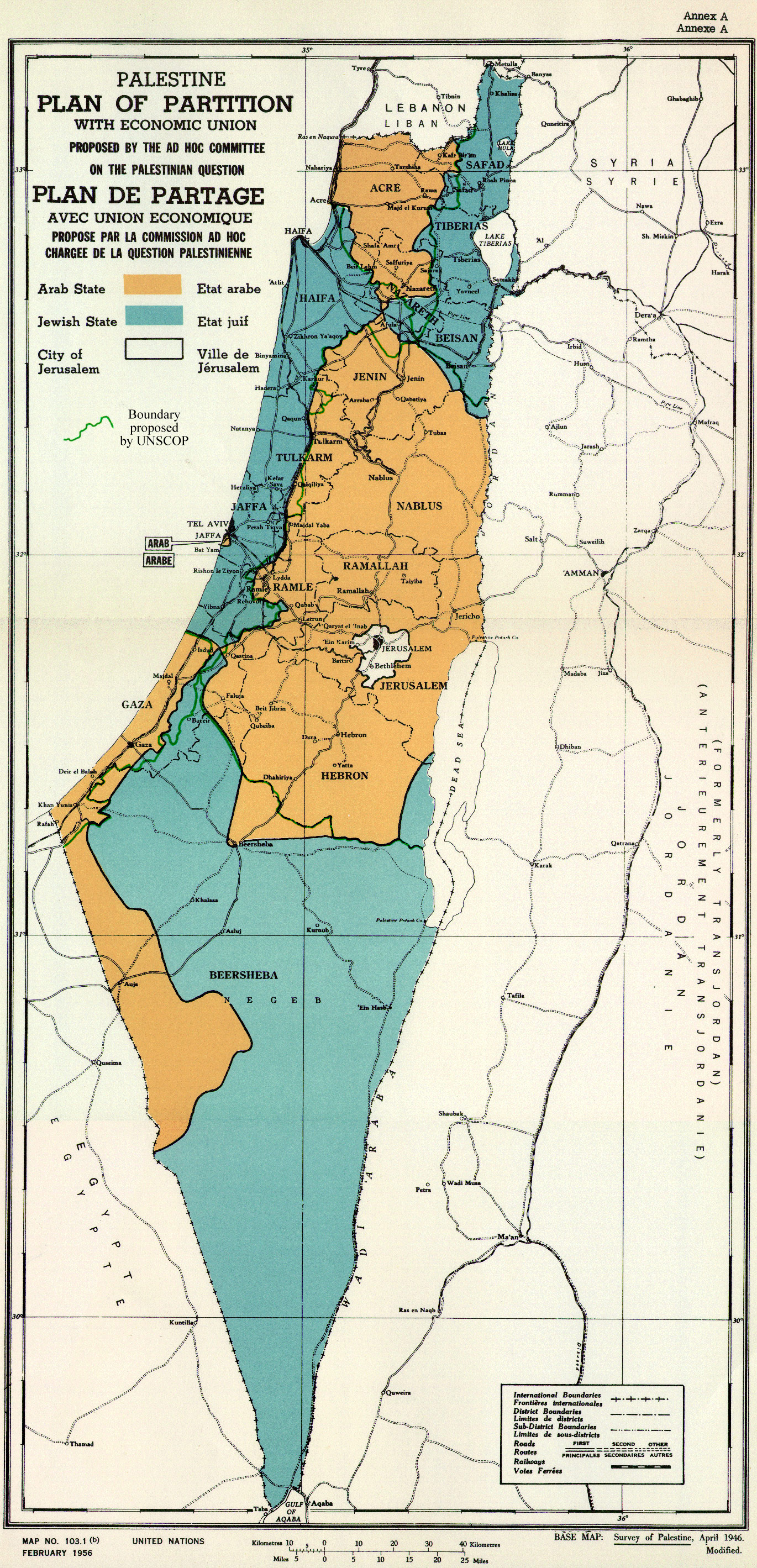
United Nations, Map No. 103.1(b), February 1956. Base map: Survey of Palestine, April 1946.
SEE MORE:
Israel–Palestine foundational documents
Wars and conflict references
Zionism as a National Liberation Movement (Jacob Tsur, 1970).pdf
RELATED CLAIMS:
Arabs Peacefully Accepted Jewish Immigration Before 1948
Jews Lived Peacefully in the Arab World Until Zionism
Israel was created by the United Nations in 1947
Israel Started the 1967 Six-Day War
Israel is a settler-colonial project
Early Zionism aimed to displace the Arab population from the beginning
A Jew and an Arab walk into a bar...
"The Arabs never miss an opportunity to miss an opportunity." — Abba Eban, Geneva Peace Conference, December 1973