CLAIM:
Israel was created by the United Nations in 1947 when the UN voted to establish a Jewish state.
STATUS:
Misleading.
KEY COUNTERPOINTS:
-
The UN General Assembly does not have the legal authority to create states. Under the UN Charter, General Assembly resolutions are recommendations only. Only Security Council resolutions adopted under Chapter VII carry binding force.
-
UN Resolution 181 was a partition proposal — a recommended framework. It did not create borders, transfer sovereignty, or establish a government. The Jewish leadership accepted it; Arab leadership rejected it and went to war to prevent its implementation.
-
Israel came into existence through an act of self-declaration on May 14, 1948, followed by immediate international recognition — not through UN action. The state was proclaimed by the Jewish People’s Council at the Tel Aviv Museum, on the day the British Mandate expired, by virtue of what the declaration called “natural and historic right.”
-
The UN admitted Israel as a member state only in May 1949, a full year after its founding — which itself confirms that the UN did not create Israel but rather recognized an already-existing state.
EVIDENCE:
-
Resolution 181, adopted November 29, 1947, proposed dividing Mandatory Palestine into a Jewish state and an Arab state. The vote was 33 in favor, 13 against, 10 abstentions. Britain abstained.
-
Arab states rejected Resolution 181 and declared their intention to prevent its implementation by force. On May 15, 1948 — the first day of Israeli independence — Egypt, Syria, Jordan, Lebanon, and Iraq invaded.
-
The United States recognized Israel de facto on May 14, 1948, within minutes of the declaration, through a statement by President Truman. The Soviet Union was the first to extend full de jure recognition on May 17, 1948.
-
Israel’s Declaration of Independence explicitly invokes both “natural and historic right” and the UN resolution — citing the resolution as political legitimization, not as the legal act of creation itself.
PRIMARY SOURCES:
UN General Assembly Resolution 181 — Partition Plan for Palestine (1947) https://avalon.law.yale.edu/20th_century/res181.asp
The full text of Resolution 181, available through Yale Law School’s Avalon Project. Establishes conclusively that the resolution was structured as a recommendation to the British Mandatory power and to UN member states — not a binding act of state creation.
“The measures taken by the Commission, within the recommendations of the General Assembly, shall become immediately effective unless the Commission has previously received contrary instructions from the Security Council.”
Israel’s Declaration of Independence (May 14, 1948) — Avalon Project, Yale Law School
https://avalon.law.yale.edu/20th_century/israel.asp The full authenticated text of the declaration. The state was proclaimed “by virtue of our natural and historic right and on the strength of the Resolution of the United Nations General Assembly” — language that demonstrates the UN resolution was cited as political context, not as the mechanism of creation.
“We hereby declare the establishment of a Jewish State in Eretz-Israel, to be known as the State of Israel.”
U.S. Recognition of the State of Israel — National Archives https://www.archives.gov/milestone-documents/press-release-announcing-us-recognition-of-israel The National Archives press release documents Truman’s recognition statement on May 14, 1948 — the same day as the declaration, not a result of UN action.
“At midnight on May 14, 1948, the Provisional Government of Israel proclaimed a new State of Israel. On that same date, the United States, in the person of President Truman, recognized the provisional Jewish government as de facto authority of the Jewish state.”
UN Charter Chapter IV — Powers of the General Assembly https://www.un.org/en/about-us/un-charter/chapter-4 The UN Charter itself. Article 10 limits General Assembly authority to making “recommendations” to member states and to the Security Council. No provision grants the General Assembly authority to establish states or transfer territory.
“The General Assembly may discuss any questions or any matters within the scope of the present Charter…and…may make recommendations to the Members of the United Nations or to the Security Council.”
Creation of Israel, 1948 — U.S. State Department Office of the Historian https://history.state.gov/milestones/1945-1952/creation-israel The official State Department historical account of Israel’s creation. Confirms the sequence: British Mandate expiration, declaration of independence by Jewish leadership, immediate U.S. recognition — in that order.
“On May 14, 1948, David Ben-Gurion, the head of the Jewish Agency, proclaimed the establishment of the State of Israel. U.S. President Harry S. Truman recognized the new nation on the same day.”
STRONGEST COUNTER ARGUMENTS WORTH KNOWING:
-
The UN vote provided the most significant international legitimization for the partition concept since the League of Nations Mandate. Without Resolution 181, the political landscape for Israeli independence would have been far more hostile. Historians who emphasize the resolution’s importance are not wrong about its political weight — they are wrong to conflate political significance with legal creation.
-
Some legal scholars argue that Resolution 181, adopted by a two-thirds majority on an “important question,” had quasi-binding moral force even if not legally binding in the strict Charter sense. This is a genuine legal debate. However, even within that debate, no scholar argues the resolution alone created the state — it still required declaration, war, and recognition.
-
Israel’s own Declaration of Independence references Resolution 181, which some read as the new state granting it legitimizing weight. This is accurate — but the declaration also grounds statehood in “natural and historic right,” which predates and supersedes the UN resolution in the document’s own framing.
NOTES:
The specific claim that the UN "created" Israel in 1947 collapses the moment the sequence of events is laid out plainly. The vote was in November 1947. The state was declared in May 1948. No state was created in 1947. The resolution proposed partition; it did not implement it. Arab armies invaded specifically because the UN had not created a state and they intended to prevent one from forming.
Tactical communication note: This claim is often used to delegitimize Israel by implying the state was an external imposition by a foreign body. The correction cuts both ways: Israel declared itself — which is a stronger act of self-determination than being created by international committee. The Jewish people’s council proclaimed statehood; they were not handed it. Pointing this out reframes the conversation toward agency and self-determination rather than external legitimacy.
Misleading framing to watch for: The phrase “created by the UN” subtly implies that Israel would not exist without international permission, and therefore that international bodies could revoke its legitimacy. The historical record shows the opposite: Israel exists as a result of declaration, military defense, and recognition — the same processes by which virtually every other modern state came into existence.
***For further knowledge:
map of proposed Jewish state, Arab state, Jerusalem international zone: (29 November 1947)***
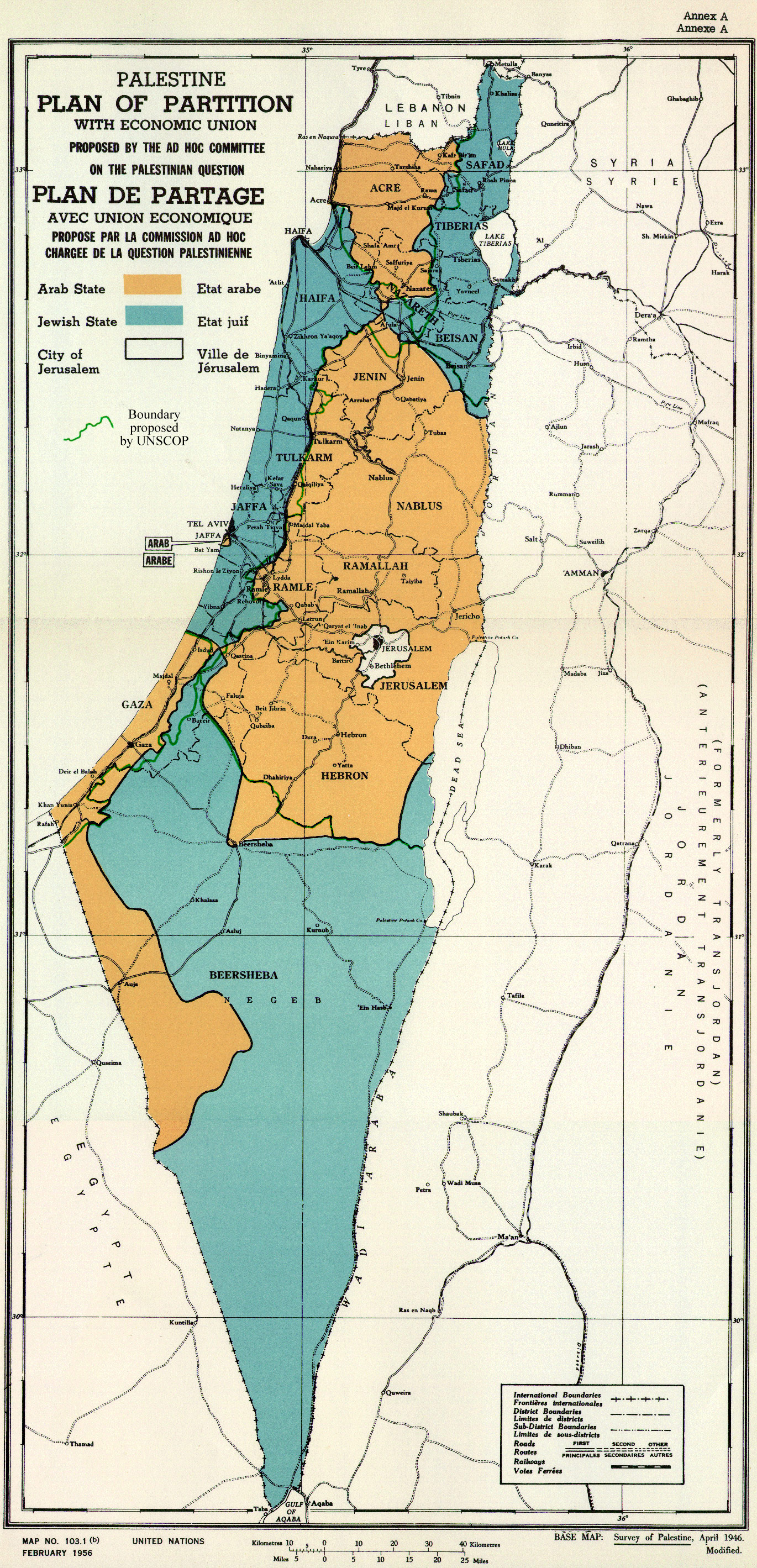
United Nations, Map No. 103.1(b), February 1956. Base map: Survey of Palestine, April 1946.
**See more
Israel–Palestine foundational documents
SETTING THE RECORD STRAIGHT, ISRAEL AND AGENDA ITEM 7.pdf
UN General Assembly Resolution 181, Partition Plan (1947).pdf
RELATED CLAIMS:
Palestine existed as a country before Israel
The Conflict Began Only in 1948
Arabs Peacefully Accepted Jewish Immigration Before 1948
Israel’s Conflict with Palestine Is a Simple Colonial Settler Project
Israel enforces an illegal occupation