CLAIM:
The Israel-Palestine conflict is a simple colonial settler project in which foreign Jewish settlers displaced the indigenous Palestinian population.
STATUS:
Misleading
KEY COUNTERPOINTS:
-
The word “simple” in the claim does the most damage to its credibility, and pressing on it directly is the most effective opening move in any debate. The claim does not merely say the conflict has colonial features; it says the conflict is a “simple colonial case.” No serious historian of the conflict, including those who apply a settler-colonial framework, defends the simple version. Acknowledging complexity is not a concession; it is the factually accurate position. Ask the opponent to specify whether they mean the simple or a qualified version, because the answer determines whether any real analytical claim is being made.
-
The “foreign settler” premise collapses when applied to Jewish history, because Jews are not foreign to the Land of Israel in any historically meaningful sense: continuous Jewish presence in the territory is documented from ancient history through every subsequent period of foreign imperial rule without interruption. The diaspora was a dispersion under Roman conquest, not a clean erasure. Jewish communities existed in Jerusalem, Safed, Hebron, and Tiberias throughout the Ottoman period and into the Mandate era, documented in Ottoman census records and the accounts of European consuls and travellers across multiple centuries. Returning to a land from which one’s people were forcibly expelled by foreign empires, and in which a remnant community persisted, is categorically different from Europeans arriving in the Americas or Australia with no prior historical claim.
-
Classic settler-colonialism requires a colonizing metropole directing settlers to extract resources for an imperial home state, and no such metropole exists in the Zionist case. The model was developed to describe British expansion into Australia, French expansion into Algeria, and Dutch expansion into South Africa: state-sponsored projects serving imperial economic and strategic interests. Zionism arose from stateless, persecuted Jews seeking national self-determination with no sponsoring empire. Britain, the closest candidate, actively restricted Jewish immigration through the 1939 White Paper, imposed strict quotas during the Holocaust, and fought Zionist forces before 1948. A colonial project whose alleged metropole was interning Holocaust survivors in Cyprus is not applying the model; it is stretching it past its analytical limits. The more responsible formulation is that some features of Zionist settlement resemble settler-colonial patterns in specific respects, which is a qualified and debatable claim, not a simple one.
-
Over half of Israeli Jews descend not from European settlers but from Mizrahi and Sephardi Jews expelled or forced to flee Morocco, Iraq, Egypt, Yemen, Syria, Libya, Algeria, Tunisia, and Iran after 1948, making the “European settler” framing factually incorrect as a description of the Israeli Jewish population. Approximately 850,000 Jews were displaced from Arab and Muslim countries in the decade following Israeli independence, most of whom resettled in Israel. The Israeli Central Bureau of Statistics documents the demographic breakdown by continent of origin. A state whose majority population consists of refugees from Arab countries is not accurately described as a European colonial implant, and any settler-colonial analysis that ignores this demographic reality is working with a false premise.
-
**The primary drivers of Jewish immigration to Palestine were persecution, genocide, statelessness, ***and a millennia-old religious and cultural longing for Zion,***not imperial ambition or resource extraction, which removes the motivational foundation of the colonial analogy. Eastern European Jewish immigrants fled pogroms in Tsarist Russia and, later, Nazi extermination across occupied Europe. The aspiration to return to Zion was not invented by 19th-century political Zionism; it is embedded in daily Jewish prayer, in Passover liturgy, in the dirges of Tisha B’Av, and in the unbroken textual and devotional life of the Jewish people across the entire diaspora period. There were no resources to extract, no empire to serve, and no home state to enrich. The motivation was survival, self-determination, and the fulfillment of a religious and national longing that predates the modern nation-state by roughly two thousand years. Applying a framework designed to describe economically motivated imperial expansion to refugees returning to an ancestral homeland they had never stopped mourning requires stripping the historical and spiritual context from the people whose movement is being analyzed.
-
The legal framework that produced Israeli statehood was not a colonial imposition but an application of self-determination norms to a stateless people, expressed through the League of Nations Mandate (1922) and UN Resolution 181 (1947). The Mandate explicitly recognized the historical connection of the Jewish people to Palestine as the basis for reconstituting a national home there. Resolution 181 proposed partition into two states as a self-determination outcome for two peoples. These instruments did not transfer Palestine to a foreign empire; they recognized a national movement’s right to statehood in its ancestral territory. No prior sovereign Palestinian Arab state existed in the territory to be displaced: the land was governed by the Ottoman Empire until 1918 and then by British administration. A colonial framework that requires erasing the absence of prior Palestinian sovereignty to function is not an analysis; it is a conclusion in search of a map.
-
The colonial model forces a historically complex conflict into a simple oppressor-victim binary that the actual record does not support, and accepting that binary uncritically means accepting a political conclusion dressed as historical analysis. The conflict involves two national movements with competing claims to the same territory, not a straightforward case of foreign colonizers arriving in an inhabited land with no prior connection to it. Jewish historical connection, the legal recognition of Jewish self-determination, the indigeneity argument, the Mizrahi demographic reality, and the absence of prior Palestinian sovereignty are all facts that the colonial framework has to actively suppress to reach its conclusion. A framework that can only function by ignoring multiple documented historical realities is not explaining the conflict; it is predetermining who the villain is. The colonial label is a verdict, not an analysis, and should be treated as such in debate.
EVIDENCE:
• The League of Nations Mandate for Palestine (1922) explicitly cited the historical connection of the Jewish people to Palestine as the legal basis for facilitating a Jewish national home, distinguishing the Jewish claim from colonial settlement by an unconnected foreign population.
• UN General Assembly Resolution 181 (November 29, 1947) proposed the establishment of both an Arab state and a Jewish state in the territory, framing the outcome as a self-determination partition, not a colonial transfer to a foreign power.
• No sovereign Palestinian Arab state existed at any point before 1948. The territory was governed by the Ottoman Empire until 1918 and by British Mandatory administration from 1920 to 1948. Sovereignty was imperial throughout, not Palestinian.
• The British White Paper of 1939 imposed strict limits on Jewish immigration to Palestine at the height of Nazi persecution, cutting the annual quota to 15,000 and prohibiting further immigration after five years without Arab consent. This is the behavior of a metropole suppressing its supposed colonial project, not sponsoring it.
• Israel Central Bureau of Statistics demographic data documents that more than half of Israeli Jews are of Asian or African origin, the majority descending from Jewish refugees from Arab and Muslim countries, not European immigrant populations.
• Jewish communities in Jerusalem, Hebron, Safed, and Tiberias are documented continuously in Ottoman records and European consular reports throughout the 18th and 19th centuries, establishing that Jewish presence in the territory predates modern Zionist immigration and was not created by it.
PRIMARY SOURCES:
• League of Nations Mandate for Palestine (1922)
https://www.un.org/unispal/document/auto-insert-201057/
The foundational international legal document recognizing Jewish historical connection to Palestine and establishing the framework for a Jewish national home. Directly defeats the claim that Israeli statehood was a colonial imposition rather than a self-determination outcome recognized in international law.
“Whereas recognition has thereby been given to the historical connection of the Jewish people with Palestine and to the grounds for reconstituting their national home in that country…”
↑↑↑ Best source!
• UN General Assembly Resolution 181 (November 29, 1947)
https://avalon.law.yale.edu/20th_century/res181.asp
The UN partition plan proposing two states for two peoples. Documents that international consensus framed the outcome as self-determination for both communities, not colonial settlement of one.
“Independent Arab and Jewish States… shall come into existence in Palestine…”
↑↑↑ best source!
• Balfour Declaration (November 2, 1917)
https://avalon.law.yale.edu/20th_century/balfour.asp
British government declaration supporting a Jewish national home while explicitly protecting existing non-Jewish communities. Establishes early international recognition of Jewish claims and documents that the framework included protections for the Arab population.
“His Majesty’s Government view with favour the establishment in Palestine of a national home for the Jewish people, it being clearly understood that nothing shall be done which may prejudice the civil and religious rights of existing non-Jewish communities in Palestine…”_
↑↑↑ best source!
• British White Paper (May 1939)
https://avalon.law.yale.edu/20th_century/brwh1939.asp
The 1939 British policy restricting Jewish immigration to 75,000 over five years and prohibiting further immigration without Arab consent, issued at the height of Nazi persecution. Directly undermines the claim that Britain functioned as a sponsoring metropole for a Jewish colonial project.
“And the number of illegal Jewish immigrants now in the country, this would allow of the admission, as from the beginning of April this year, of some 75,000 immigrants over the next five years. These immigrants would, subject to the criterion of economic absorptive capacity, be admitted as follows:…”
↑↑↑ best source!
• A Survey of Palestine, Vol. I (1945 to 1946)
https://yplus.ps/wp-content/uploads/2021/01/A-SURVEY-OF-PALESTINE-DEC-1945-JAN-1946-VOL-I.pdf
British Mandatory government survey covering population, immigration patterns, land ownership, and land tenure across the territory. Documents the complexity of land ownership and population distribution that contradicts a simple displacement narrative. Notable that this source was produced by the British administration, not by either party to the conflict.
↑↑↑ mid source
• Israel Central Bureau of Statistics, Statistical Abstract of Israel 2024, Table 2.9
https://www.cbs.gov.il/he/publications/doclib/2024/2.shnatonpopulation/st02_09.pdf
Official demographic breakdown of Israeli Jews by continent of origin and immigration period. Documents that over half of Israeli Jews are of Asian or African origin, directly refuting the “European settler” demographic premise.
↑↑↑ mid source
• Declaration of the Establishment of the State of Israel (May 14, 1948)
https://catalog.archives.gov.il/site/en/chapter/the-declaration-of-independence/
Israel’s founding declaration articulating the historical and legal basis for Jewish statehood and its stated commitment to equal civic rights for all inhabitants regardless of religion or ethnicity. Useful for the self-determination framing and for the Arab citizenship argument.
“We… hereby declare the establishment of a Jewish State in Eretz-Israel, to be known as the State of Israel… it will ensure complete equality of social and political rights to all its inhabitants irrespective of religion, race or sex…”
↑↑↑ mid source
BONUS: Case study: “Disappearing Palestine” map meme
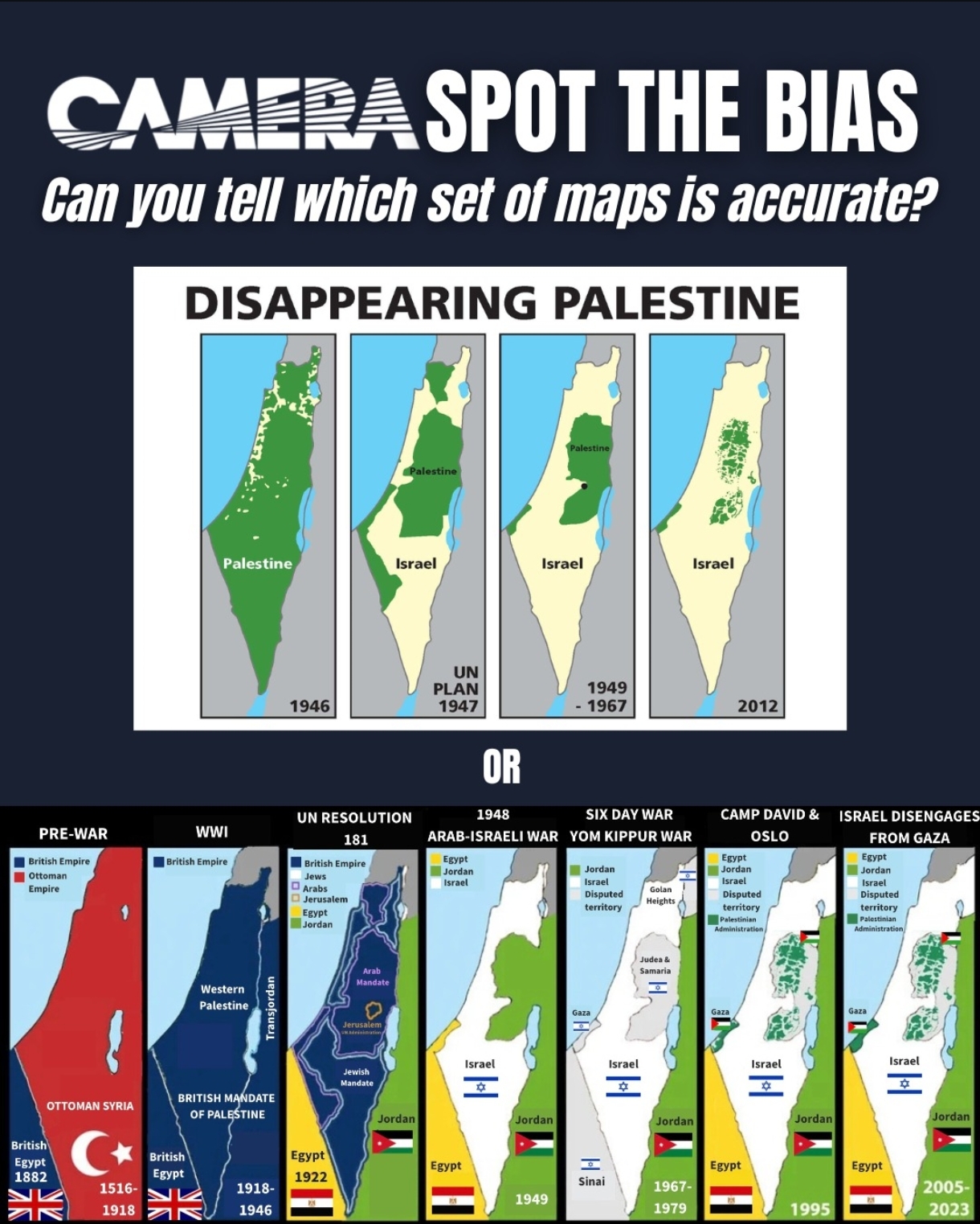
CAMERA (Committee for Accuracy in Middle East Reporting and Analysis), "Spot the Bias: Disappearing Palestine vs. Historical Timeline," camera.org
This meme is misleading because the four panels do not show the same category of control, ownership, or sovereignty.
-
The 1946 panel does not show a sovereign Palestinian state. It treats non-Jewish areas as if they were all one Palestinian national territory, which is not accurate.
-
**The 1947 panel shows a UN partition proposal, not actual sovereign land division.
-
**The 1949-1967 panel shows Jordanian control of the West Bank and Egyptian control of Gaza, not an independent Palestinian state.
-
The 2012 panel switches again to Palestinian-administered or Palestinian-populated areas, not the same kind of category shown in the earlier panels.
By contrast, the lower timeline is closer to the historical reality because it distinguishes between different legal and political phases instead of pretending all four top panels show the same thing.
STRONGEST COUNTER ARGUMENTS WORTH KNOWING:
• The most serious scholarly version of the settler-colonial argument does not claim the conflict is simple. Patrick Wolfe, the framework’s leading theorist, identifies “elimination of the native” as the defining logic of settler-colonialism, and some scholars argue this logic is visible in specific Israeli policies toward Palestinians in the West Bank and Gaza, regardless of the historical origins of Zionism. This qualified version cannot be dismissed by pointing to Jewish indigeneity; it requires engagement with specific policies and their effects.
• A strong version of the opposing argument acknowledges that most Israeli Jews are not European while arguing that Ashkenazi Jews dominated Zionist leadership, early state institutions, and foundational land acquisition, meaning the Mizrahi demographic does not fully neutralize the European-origin critique of the founding generation.
• Critics of the “no metropole” argument point out that Wolfe and subsequent settler-colonial theorists explicitly revised the framework to allow for cases without a conventional metropole, arguing that the settler-colonial structure can become self-perpetuating once established. This makes the “no metropole” counterpoint weaker against an academically informed opponent than against a general audience.
• The 1939 White Paper is sometimes cited in reverse: as evidence that Zionist settlement had already advanced so far that Britain could no longer control it, rather than as evidence that Britain was suppressing a colonial project. Defenders of the colonial framing argue that Zionist settler society had achieved sufficient autonomous momentum by 1939 to operate independently of British support.
NOTES:
The word “simple” is the fastest debate entry point and should be used first. It reframes the entire exchange: the opponent must defend oversimplification, not just the general analogy. Most academically literate opponents will retreat to a qualified version, at which point the debate shifts to specifics rather than the sweeping claim.
The 1939 White Paper is underused in this debate. It is the single most direct documentary evidence against the “Britain as sponsoring metropole” argument and it was produced by the alleged metropole itself. Quote it when the British imperial sponsorship argument is raised.
The Mizrahi argument is strong against a lay audience but weaker against a sophisticated opponent who will respond with the Ashkenazi founding-generation point. Use it as a supporting argument, not the primary one, and be ready for the founding-generation response.
Watch for the “Zionism created Palestinian nationalism as a reaction” framing. It is a separate claim that can derail the debate into a sequencing argument. The counterpoint is that both Jewish and Arab national movements developed in the late 19th century in response to Ottoman modernization and European nationalist ideas, not in a simple cause-and-effect chain.
Burden of proof on “simple colonial case” is fully with the claimant. The legal documents, the demographic data, and the absence of prior Palestinian sovereignty together establish that the “simple” version requires ignoring multiple documented historical facts. The opponent must explain what they mean by “simple” or the claim has no defensible content.
***For further knowledge:
map of proposed Jewish state, Arab state, Jerusalem international zone: (29 November 1947)***
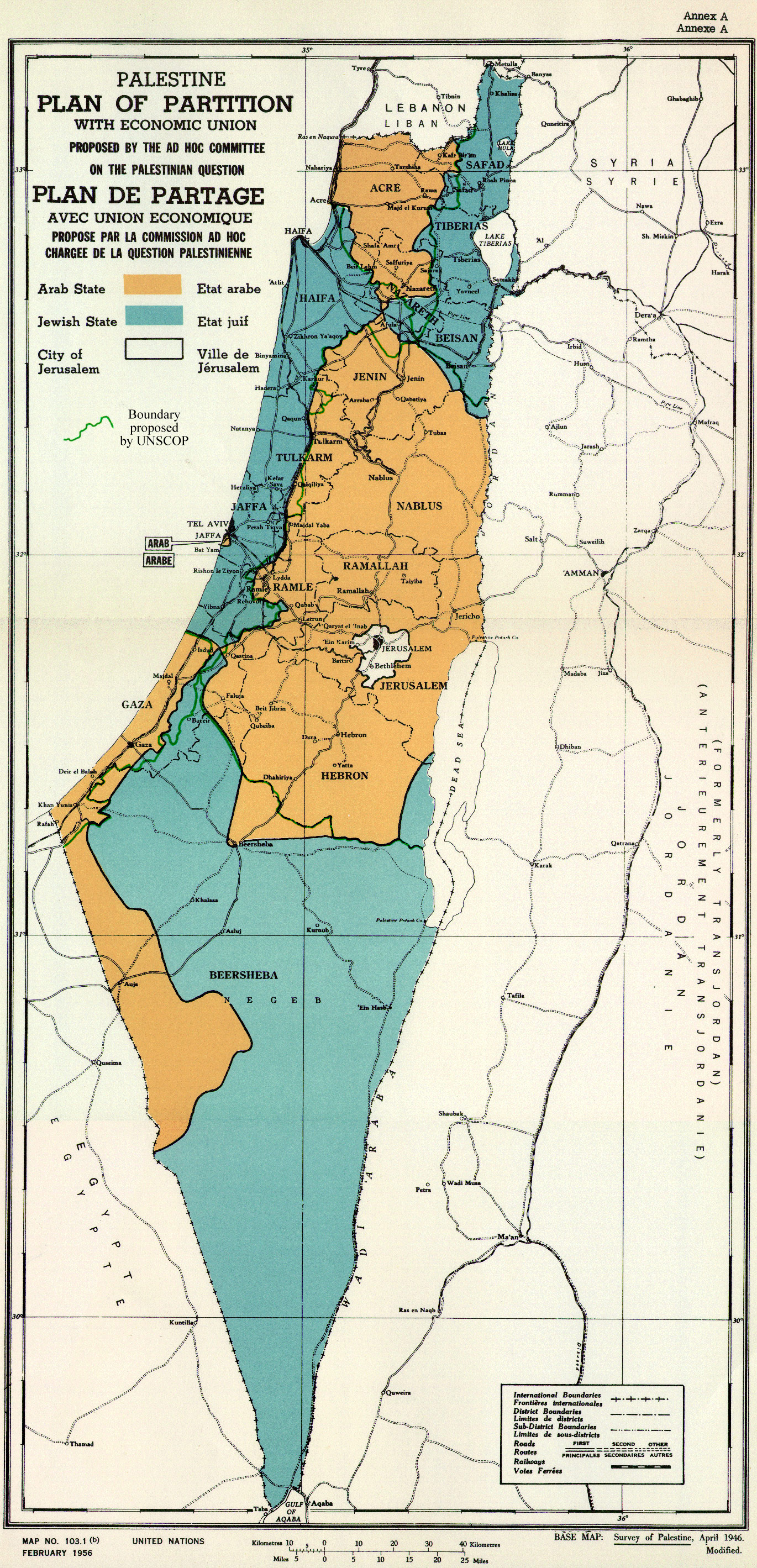
United Nations, Map No. 103.1(b), February 1956. Base map: Survey of Palestine, April 1946.
if settler colonial means migration into contested land, then also the Palestinians are colonialists because the majority of them were Arab migrants at the times of the Ottoman Empire
__see more:
Israel–Palestine foundational documents
World Zionist Organization Constitution (1960).pdf
A Guide to Recognizing When Anti-Israel Actions Become Antisemitic
Herzl’s Road to Zionism.pdf
__Related claims:
Israel is a settler-colonial project
Best Similar Claim!↑↑↑↑↑↑↑↑↑↑↑↑↑↑↑↑
Jews are not indigenous to the land of Israel
Jews did not live in Israel for 3000 years consecutively
Palestine existed as a country before Israel
Israel is a settler-colonial project
The Conflict Began Only in 1948
There is no archaeological evidence that Jews lived in Israel in ancient times
"It doesn't matter what the world says about Israel; it doesn't matter what they say about us anywhere else. The only thing that matters is that we can exist here on the land of our forefathers." — David Ben-Gurion, as quoted by Ariel Sharon, The 50 Years War documentary, 1999